Using 'now' in past-tense narrative

Now, I have a friend who has suggested that all writers have a series of literary 'tics', as it were, subconscious patterns they end up overusing, and that 'now' might be one of mine. (I also just realized how this paragraph started, so I think my friend may be right.) Anyway, my friend thinks it might benefit me to treat 'now' as, at the very least, an indication that a sentence could use some closer attention.
That's one that pulls me up every time I find it during edit, for the reasons you've articulated. My usual fix is to find another word that doesn't have the same tense disconnect as "now". It's a contradiction within itself, if your narrative is past tense.

My worst tic, for a long time, was, "blah blah blah, and then..." Generally you need one or the other, but rarely if ever do you need both. It got to the point where I'd do a Find Word check. Along with "just". That's another over-used word, I reckon.
The fact remains, though, that I don't see anything inherently wrong with using the 'circumstance' definition, even in past tense, and there are just some sentences where trying to avoid using it entirely leads to some (in my opinion) very awkward presentation. My editor insists on reminding me on every story I send him anyway.
Err on the side of convention is generally the safest route. Good editors are usually right, except when they're wrong...
 
If you're not arguing that, why did you tell him the rule is not to use now in past-tense writing? That's straight-up incorrect.
For the same reason you don't explain subatomic particles in 5th grade science.

I'm not telling the AH at large not to experiment. The AH at large didn’t ask. I'm telling the FNG that if they have to ask the answer is no, and to listen to their editor until such time as they no longer need an editor.
 
That's a good quote, and the one that gets mentioned the most online (IMO), but my favorite line is from the pilot episode and I think it's a superb encapsulation of the show and the character. From his ex-wife:
[Raylan], you do a good job of hiding it, and I suppose most folks don't see it, but honestly, you're the angriest man I have ever known.
 
This is an excellent thread, both the question and the discussion. This is something I've struggled with myself in the past. I feel a little better now seeing how many writers say that they don't see a problem using "now" in past tense narrative -- with that said, I'm still not entirely sure myself :) At least I'll allow myself the latitude to include/use it occasionally (I was going to say use it every "now" and then, but... that would've been terrible).
 
From my most successful story:

I can't see how there's anything wrong with that.
If that was me, I'd lose the "now", because I'd say "evening" by itself is sufficient. This might be a stylistic choice, for sure, as I have no idea where it sits, grammatically.

I find my biggest bug-a-boo during edit is the little words that we use so often. I look at them and think, are they in fact adding meaning? Or are they there because I've not got rid of them yet?
 
"It was evening now" indicates a change of state that "it was evening" does not.
True, but it's a bit redundant (to me) - unless there's already been a focus on the passing of time. But from the snippet in isolation, one can't tell.
 
now(nou)adv.1. At the present time: goods now on sale; the now aging dictator.2. At once; immediately: Stop now.3. In the immediate past; very recently: left the room just now.4. At this point in the series of events; then: The ship was now listing to port.5. At times; sometimes: now hot, now cold.6. Nowadays.7. In these circumstances; as things are: Now we won't be able to stay.8.a. Used to introduce a command, reproof, or request: Now pay attention.b. Used to indicate a change of subject or to preface a remark: Now, let's get down to work.
 
My worst tic, for a long time, was, "blah blah blah, and then..." Generally you need one or the other, but rarely if ever do you need both. It got to the point where I'd do a Find Word check. Along with "just". That's another over-used word, I reckon.
I actually keep a list of the tics I've noticed that I do a search for on final polish before sending it off.
For the same reason you don't explain subatomic particles in 5th grade science.

I'm not telling the AH at large not to experiment. The AH at large didn’t ask. I'm telling the FNG that if they have to ask the answer is no, and to listen to their editor until such time as they no longer need an editor.
Might I suggest that you actually check out some of my work before assuming my skill level and motivations? I know what my skill level is, I know what my confidence level is, and I don't believe in 'no longer need an editor'. Everyone makes mistakes, overlooks obvious improvements, misses things. A second set of eyes is ALWAYS helpful, in my opinion.

I feel a little better now
Yes, yes you do.

I find my biggest bug-a-boo during edit is the little words that we use so often. I look at them and think, are they in fact adding meaning? Or are they there because I've not got rid of them yet?
Oh my god, I have to kill so many 'that's from my writing. "She realized that she was in over her head, but knew that she had no way to get out." (Also just noticed that I actually did it in the above reply to you... and again just now.) Seriously, brain, stop that!
 
Might I suggest that you actually check out some of my work before assuming my skill level and motivations? I know what my skill level is, I know what my confidence level is, and I don't believe in 'no longer need an editor'. Everyone makes mistakes, overlooks obvious improvements, misses things. A second set of eyes is ALWAYS helpful, in my opinion.
You didn't ask for that. You asked about the definition of a word that you could have looked up on your own which, as others have screen capped, clearly says this usage of the word is fine.

The question now is whether you're going to let your editor or me stop you.

EDIT: I'll just pre-emptively throw in a "Mazel Tov"
 
You didn't ask for that. You asked about the definition of a word that you could have looked up on your own which, as others have screen capped, clearly says this usage of the word is fine.
To be clear, the 'second set of eyes' I referred to was still having an editor review my work. Here, I was just raising a conversation about the topic, largely to mess with him because I was pretty sure what the overall response would be. I've already shown him definitions and examples. He still does it anyway.
The question now is whether you're going to let your editor or me stop you.
Never have, and I don't intend to start now.
EDIT: I'll just pre-emptively throw in a "Mazel Tov"
Huh?
 
From my most successful story:

Joe sat up and looked out the window. It was evening now, and the city was dark until they rolled into the brightly lit station.

I can't see how there's anything wrong with that.
Personally, I think the "now" is both unnecessary and detrimental.

Joe sat up and looked out the window. It was evening, and the city was dark until they rolled into the brightly lit station.

What does this version lose without "now" in it?
 
I looked up some more authors. Elizabeth George, whom I also regard as a reliable stylist, also uses "now" in past tense.

Its meaning is contextual.

If you write: "Joe gritted his teeth and cinched his belt. Now, he was ready."

It reads better and more clearly than if you write:

"Joe gritted his teeth and cinched his belt. Then, he was ready."

The "now" places the time clearly at the time of the belt being cinched. "Then" introduces a slight element of uncertainty: was Joe ready at some other time? Are we shifting to a different point in the narrative? Is the author trying to emphasize a succession of events?

Compare:

Joe gritted his teeth and cinched his belt. Now he was ready to walk into the street to meet Darnell.

v.

Joe gritted his teeth and cinched his belt. Then he walked into the street, ready to meet Darnell.

I suppose you could do both. But "now" clearly is not wrong, based on authorities and based on the practice of actual published authors. It's a matter of subtle emphasis.
 
I use 'now' in past tense when I want to create intensity and immediacy; that means I pretty much use it during sex scenes and nowhere else. But also, now can mean:
  • the present (it's warm now)
  • the immediate future (Do it now)
  • the immediate past (I had a sandwich just now)
  • indication of command (now look here)
  • indication of transition (now, what we're going to do is)
  • in these circumstances (now that it's raining, we need an umbrella)
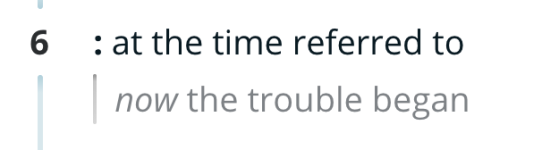
  • at an indicated time (now our hardships began)
I saw a picture of a woman protesting, from back in like the 60's or 70's. She was wearing a button that said NOW.

Luckily I have this tiny handheld device that's linked to a nearly infinite database, so I googled it. "NOW" meant National Organization of Women.

Having read my post, all viewers of the thread were now fully briefed on alternate definitions of "Now".
 
Personally, I think the "now" is both unnecessary and detrimental.

Joe sat up and looked out the window. It was evening, and the city was dark until they rolled into the brightly lit station.

What does this version lose without "now" in it?

As already explained, the passage of time.

Whether or not it is necessary is something that can be reasonably argued, but how in the world is it "detrimental"?
 
Last edited:
Here's a challenge.

There have been a number of examples as well as authorities offered on this question, which support the use of the word "now" in past tense narrative.

To anyone claiming the contrary, that it's wrong:

1. Do you have an authority that says it's wrong?
2. Can you find examples of authors you admire who steadfastly do NOT use "now" in this way? It's not hard to find free text online and do a quick search. All the fiction examples I've found so far use "now" in this way.
 
Here's a challenge.

There have been a number of examples as well as authorities offered on this question, which support the use of the word "now" in past tense narrative.

To anyone claiming the contrary, that it's wrong:

1. Do you have an authority that says it's wrong?
2. Can you find examples of authors you admire who steadfastly do NOT use "now" in this way? It's not hard to find free text online and do a quick search. All the fiction examples I've found so far use "now" in this way.


I think we are well into the "picking at the scab" portion of the thread.
 
Oh my god, I have to kill so many 'that's from my writing. "She realized that she was in over her head, but knew that she had no way to get out." (Also just noticed that I actually did it in the above reply to you... and again just now.) Seriously, brain, stop that!
Haha!

Seriously, brain, stop!

Fortunately, my list of tics is actually getting shorter, to the point I catch most of them immediately, and fix them in the flow. Which, given that I'm pretty much a stream of consciousness writer, is important.
 
As already explained, the passage of time.
Except it doesn't really, and certainly not in any way that couldn't be conveyed using past tense. For example:

Joe sat up and looked out the window. Evening had fallen, and the city was dark until they rolled into the brightly lit station.

Whether or not it in necessary is something that can reasonably argued, but how in the world is it "detrimental"?
Well, first, it can be distracting to readers. How distracting depends on how important and/or detailed the timeline is, but disrupting a reader's immersion in the story is detrimental.

Second, in my opinion, the sentence flows better without it. I don't know the proper term to explain it, but it's kind of like it causes a stutter-step there that doesn't happen without it.
 
Back
Top