Too many commas?

Yes, the word freshly is an adverb. I never said it wasn't.

So you’re saying I should sign this post as:

— by Lobster, a slightly-reddish, exceedingly-suspicious forum poster

because every adverb+adjective is a compound adjective that has to be hyphenated? That might be, but it looks silly as hell.
Yes and no. It comes down to how it's used in a sentence.

If the combination comes after the noun, such as in, "Her hand was freshly manicured," it should not be hyphenated.

If it comes before the noun, forming a compound adjective, the hyphen is proper. So, yes, your new sig line is grammatically correct.
 
Yes, the word freshly is an adverb. I never said it wasn't.


Yes and no. It comes down to how it's used in a sentence.

If the combination comes after the noun, such as in, "Her hand was freshly manicured," it should not be hyphenated.

If it comes before the noun, forming a compound adjective, the hyphen is proper. So, yes, your new sig line is grammatically correct.
So, I dig into this a little bit, and like everything in English there is no single opinion, but I kinda like the rather more complicated rule expressed in this Reddit comment.

Basically, you use hyphen if it's ambiguous whether the left side is really an adverb and could be an adjective instead, which covers cases like "well-meaning" or "fast-declining". Otherwise you don't (unless we're talking about those true compounds I mentioned earlier).

It'd be nice to have an official source for this (maybe one of the manuals of style?), but this broadly agrees with what I see in reputable publications and also with what I was falling on instinctively in my own writing.
 
'With my freshly manicured hand, I lifted my short dress, pulled my thong aside, freed my rigid cock and pointed it at my two naked sisters.'


If yes, how should it be reworded?
Depends on whose cast in the role of the speaker...

Christopher Walken:
'With, my freshly, manicured, hand, I lifted, my short dress, pulled, my thong aside, freed, my rigid cock, and pointed, it at my two, naked sisters.'

William Shatner:
'With, my, freshly, manicured, hand, I lifted, my, short, dress, pulled, my thong, aside, freed, my rigid, cock, and, pointed, it, at, my two, naked, sisters.'
 
'With my freshly manicured hand, I lifted my short dress, pulled my thong aside, freed my rigid cock and pointed it at my two naked sisters.'


If yes, how should it be reworded?
I would write it thusly.

"I lifted my short dress with a freshly manicured hand and pulled my thong aside. My cock sprang free, pointing at my wide-eyed sisters."
 
Last edited:
Back in the dark ages, I was taught the following with respect to lists and commas. A comma is NOT needed before the word “and.”

I wore a blouse and skirt. No comma needed. I believe most everyone would agree with this.

I wore a hat, a blouse and skirt. Only one comma needed to separate hat and blouse. The word “and” separates the blouse/skirt pair already, thus a comma is not needed before the “and.”

Now, I know that I will get slammed for this, but if you look at why the comma is there in the first place, the logic and instructions from my junior high school English teacher do make sense.

I will go to my bunker now.
 
Back in the dark ages, I was taught the following with respect to lists and commas. A comma is NOT needed before the word “and.”

I wore a blouse and skirt. No comma needed. I believe most everyone would agree with this.

I wore a hat, a blouse and skirt. Only one comma needed to separate hat and blouse. The word “and” separates the blouse/skirt pair already, thus a comma is not needed before the “and.”

Now, I know that I will get slammed for this, but if you look at why the comma is there in the first place, the logic and instructions from my junior high school English teacher do make sense.

I will go to my bunker now.
The comma (if given) after blouse is called the oxford comma. It has been controversial for a long time. Hemingway famously had major fights with an editor over it -- Hemmingway hated it. I had arguments about it with my doctoral advisor, she finally said fine, as long as I was consistent (she wanted it, I didn't). I have mostly come around to it in the decades since then.

I think consistency is the big key. Either way is grammatically correct. Each have instances of being better (or worse).
 
The comma (if given) after blouse is called the oxford comma. It has been controversial for a long time. Hemingway famously had major fights with an editor over it -- Hemmingway hated it. I had arguments about it with my doctoral advisor, she finally said fine, as long as I was consistent (she wanted it, I didn't). I have mostly come around to it in the decades since then.

I think consistency is the big key. Either way is grammatically correct. Each have instances of being better (or worse).

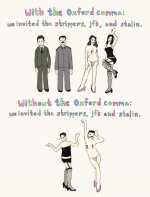
For the record, I have never heard an argument against the Oxford comma. Nobody has to use it if they don't want to, but I'm not aware of a single time it has made anything less clear or harder to read.

oxford-comma.jpeg
 
or the record, I have never heard an argument against the Oxford comma.
Hemmingway's standard argument is that commas represent breaths or pauses. But no one pauses when saying red, white and blue. It would very odd to put a pause in there. In such cases, the sentences flow more naturally with the comma.
 
Hemmingway's standard argument is that commas represent breaths or pauses. But no one pauses when saying red, white and blue. It would very odd to put a pause in there. In such cases, the sentences flow more naturally with the comma.

It would also be very odd to say "red [pause] white and blue".
 
It would also be very odd to say "red [pause] white and blue".
Actually listen to yourself. I bet you do. Or at least the vast majority of speakers do. I hear it that way. It was Hemingway's assertion that most people say it that way. White and almost blur together as a single word.
 
If you didn't pause, that would sound like you were saying red white (i.e.: pink) and blue.

Also the Shatner read would look a bit more like this:
'With my, freshly-manicured-hand, I ... lifted... my short dress, pulled my thong aside, freed... my... rigid... cock. And pointed it at my-two-naked-sisters.'

Say it aloud. You'll feel so... Canadian.
 
Not a pause as such. The grammatical functional 'and' would be an enclitic, phonetically attached to the previous word, but there are three stresses. The stresses (the final one having a slightly different intonation) are what mark it as a list of three items. There need be no pause, and normally wouldn't be.

(I don't actually think this bears very much on the choice of punctuation.)
 
So, I dig into this a little bit, and like everything in English there is no single opinion, but I kinda like the rather more complicated rule expressed in this Reddit comment.

Basically, you use hyphen if it's ambiguous whether the left side is really an adverb and could be an adjective instead, which covers cases like "well-meaning" or "fast-declining". Otherwise you don't (unless we're talking about those true compounds I mentioned earlier).

It'd be nice to have an official source for this (maybe one of the manuals of style?), but this broadly agrees with what I see in reputable publications and also with what I was falling on instinctively in my own writing.
The Chicago Manual of Style has some commentary on this, and that's about as definitive a guide there is in the USA (not elsewhere). Vol. 17, sections 7.81 through 7.89.

Generally, when you have an "ly" adverb in front of an adjective in front of a noun, you don't hyphenate. There's no need. The meaning is clear.

"Freshly manicured hands." No need for a hyphen. The words are all doing what, grammatically, they customarily do.

But "Polish-painted fingernails" would be correct, because "Polish" is a noun, not an adverb. The hyphen clarifies the meaning.
 
'With my freshly manicured hand, I lifted my short dress, pulled my thong aside, freed my rigid cock and pointed it at my two naked sisters.'


If yes, how should it be reworded?
You need a comma after "cock" and one after "two."

Oxford rules

(I'm just shitposting, don't take this seriously)
 
Not a pause as such. The grammatical functional 'and' would be an enclitic, phonetically attached to the previous word, but there are three stresses. The stresses (the final one having a slightly different intonation) are what mark it as a list of three items. There need be no pause, and normally wouldn't be.

(I don't actually think this bears very much on the choice of punctuation.)
Well, there you have it. Sounds like a regional dialect thing to me.

If you're trying to evoke a voice where the "and" is clearly separated from the word before it then use the Oxford comma. If you're trying to evoke a voice that runs them together then omit it (although for someone with my dialect that would be much more clear if you actually run the words together).
 
I was taught the following with respect to lists and commas. A comma is NOT needed before the word “and.”
Lists of actions are different, though.

Granted, separating lists of actions by "and" is, according to some, poor form by itself. But I don't think the comma rule you cite applies to it.
 
Actually, if there is any significant pausing between words, the 'and' is more likely to be proclitic, attaching to the following word: 'and blue' is said as one word. The earlier point I made about stresses is still true, but it shows you shouldn't treat my Phonology 201 lectures as gospel.
 
Back
Top