Texts and DMs in stories - how to write them - inverted commas, italics? Advice please.

I despise text messages being formatted as dialogue. They're not spoken, should not be formatted as such, and the snippet you gave is a great example why.

By the time one gets to the "speech tag," they have already interpreted the quoted text as having been spoken by the character. To learn than 'she texted back' is incredibly jarring.

As for my recommendation how to actually format messages, Emily above has the right idea; I usually do it this way. Ultimately, any other option -- like italics, names followed by a colon, fancy Unicode shenanigans -- works just fine, as long as it doesn't pretend to be spoken dialogue.

You just establish it as a text up front.

I can see your point about being halfway into an exchange before indicating its a text as a problem, but the same holds true for any of this other formatting.
You have to tell the reader what's going on regardless.
 
Noted, but I still stand by the suggestion.

I've never received negative feedback on my use of dialogue markers for text messages (save for yours), and some of the most authoritative manuals on style (e.g., CMOS) recommend it over other formats.
I will say that I think the CMOS is less definitive than that, actually. It recommends the use of standard dialogue markers in nonfiction, but in fiction:
The same treatment can be used in a novel, but because quotation marks are strongly associated with spoken words, text messages in fiction are often styled in italics or bold or a different font, whether run-in or set off as a block:
...
Back-and-forth messages between two or more texters present more of a challenge. Short and infrequent exchanges, or those where the delivery medium is incidental, may simply be integrated into the narrative with action beats:
...

Conversations set off as a block can mimic the display of mobile apps by using staggered indent levels that position outgoing texts farther to the right than incoming texts:
That's from their Shop Talk post from 2020. I haven't found more recent guidance, and the bulk of that post is some insane wishcasting about representing text messages with hybrid or multimodal formatting.

Dialogue markers work. Italics work. Spatial formatting works. All three have advantages and disadvantages. Fiction style will inevitably lag behind both technology and and the way it's used to communicate. Part of the reason I wanted to go towards spatial formatting was that when representing texts in a more visual format, I could introduce emojis -- which are key communication tools for the youth -- that otherwise look ridiculous when either inserted mid-text or spelled out [eggplant emoji water spurting emoji].
 
That's from their Shop Talk post from 2020. I haven't found more recent guidance, and the bulk of that post is some insane wishcasting about representing text messages with hybrid or multimodal formatting.
I've seen this too, but never gave it too much credence because it reads more like an author's personal blog. I really don't get what she means by using standard dialogue in nonfiction but not in fiction.

To be clear, when I say "authoritative," I'm using the term loosely. English has no de jure authority, and that's great.
 
It’s never been considered necessary to have a separate style for phone conversations, email, or other types of communication, and texts are nothing new in this regard.

Just because something isn't necessary doesn't mean it isn't good. Including multiple means of communication, but presenting them all exactly the same is a disservice to your readers (in my humble opinion).

Why settle when it's so simple to make different means of communication distinguishable?
 
I've seen this too, but never gave it too much credence because it reads more like an author's personal blog. I really don't get what she means by using standard dialogue in nonfiction but not in fiction.

To be clear, when I say "authoritative," I'm using the term loosely. English has no de jure authority, and that's great.
The only reason I give it more credence than a personal blog is that the CMOS links to this post in answers about the topic. And yeah, we're not talking about scripture here. It's not the WORD OF THE LORD or anything. So we're on the same page there.

I think the difference between fiction and nonfiction with regard to formatting here is the amount of dialogue the reader can expect. The post says that in fiction,
quotation marks are strongly associated with spoken words
which is something that's come up in the thread. Because the leading punctuation introduces an assumed action, changing the formatting to remove that assumption has benefits for clarity. Non-fiction (and the post specifically says "no-nonsense nonfiction" like academic articles or reports) tends to have limited dialogue, if any, and frequently uses quotation marks to indicate quotes from written texts, something that hardly ever happens in fiction. When written communication, like a letter, is quoted in fiction it's usually in my experience indicated with either italics and/or some sort of spatial formatting, like section breaks and spacing:
And just as he had begun to worry seriously about Marcel Gruey's chances of getting a flight to Lisbon, he saw the note she had left:

The stone dog at the north corner-edge of the first house we lived in is a dubok -- the head is loose and can be lifted off.

So the baseline assumption of what the punctuation means is different. If I'm reading Gabrielle Must Die and quotes open, I'm assuming someone's about to talk. If I'm reading "Processed Cereals and Pulses in the Late Bronze Age" opened quotes don't carry that assumption. Italicizing texts makes it a visual indicator of written communication in fiction.
 
The only reason I give it more credence than a personal blog is that the CMOS links to this post in answers about the topic. And yeah, we're not talking about scripture here. It's not the WORD OF THE LORD or anything. So we're on the same page there.

I think the difference between fiction and nonfiction with regard to formatting here is the amount of dialogue the reader can expect. The post says that in fiction,

which is something that's come up in the thread. Because the leading punctuation introduces an assumed action, changing the formatting to remove that assumption has benefits for clarity. Non-fiction (and the post specifically says "no-nonsense nonfiction" like academic articles or reports) tends to have limited dialogue, if any, and frequently uses quotation marks to indicate quotes from written texts, something that hardly ever happens in fiction. When written communication, like a letter, is quoted in fiction it's usually in my experience indicated with either italics and/or some sort of spatial formatting, like section breaks and spacing:


So the baseline assumption of what the punctuation means is different. If I'm reading Gabrielle Must Die and quotes open, I'm assuming someone's about to talk. If I'm reading "Processed Cereals and Pulses in the Late Bronze Age" opened quotes don't carry that assumption. Italicizing texts makes it a visual indicator of written communication in fiction.


The challenge with that is how do you know if your readers make the same assumptions?

We've had discussions here with people using some of these same formats, italics in particular, to mean all kinds of other things.
 
The challenge with that is how do you know if your readers make the same assumptions?

We've had discussions here with people using some of these same formats, italics in particular, to mean all kinds of other things.
You're still formatting it as dialogue, just with a different indicator. Using the example in the blog post:
When her phone finally chirped, the text was short: Joe’s at 10?
And then that might continue to look like:
When her phone finally chirped, the text was short: Joe’s at 10?

No, I can't make it,
she replied.

Why not? Blah blah blah.
 
I use alternating right/left align plus </br> to put Sent messages on the right and Received messages on the left, and inserting manual line breaks to hopefully prevent them from running to the wrong side of the page. Here's how it ends up looking, and what it looks like in Word after I've put the HTML in. Edit: put my text in purple just to make it a lil easier to see what's screenshot and what's post.

View attachment 2582685


View attachment 2582686
Ohh ho ho, someone's fancy :p also I'm jealous I never thought of this; I'll have to try it myself sometime :)
 
You're still formatting it as dialogue, just with a different indicator. Using the example in the blog post:

And then that might continue to look like:

But if I've already established it as a text, I just don't see the value of italics vs quotes.

It's purely a stylistic choice, no wrong answers as long as the reader understands what's going on.
 
I read some forum posts on this topic recently because I am tempted to use a lot of texts in one of my future stories and the stuff with 'p align' and 'div' and '<br>' looks really nice but the examples of how to do it sent the fear of God coursing through my veins
 
I read some forum posts on this topic recently because I am tempted to use a lot of texts in one of my future stories and the stuff with 'p align' and 'div' and '<br>' looks really nice but the examples of how to do it sent the fear of God coursing through my veins

It's all fun and games until there is another weird Lit glitch...
 
But if I've already established it as a text, I just don't see the value of italics vs quotes.

It's purely a stylistic choice, no wrong answers as long as the reader understands what's going on.
Agreed, no wrong answers if the reader gets what's going on. Once you've established that italics mean text, though, you can start leading with them like they're quotes in dialogue without having ambiguity. That can be a useful tool, especially if you ever have to mix communication methods, like the scene in Sherlock or, less elaborately, if two people are having a meatspace conversation while one of them is texting simultaneously.
 
I read some forum posts on this topic recently because I am tempted to use a lot of texts in one of my future stories and the stuff with 'p align' and 'div' and '<br>' looks really nice but the examples of how to do it sent the fear of God coursing through my veins
It's not that bad (though maybe it's different depending on what platform you write in). I use a macro in Word to handle basic formatting, like the underlining. So I start by writing out the conversation:
Sent at 5:00 am by Gemma G. Gemma
blah

Sent at 5:01 am by Yma

blah
And I don't touch it until I've finished the story or the chapter. Once I'm finished with content, I wrap everything in tags. Usually at this point I'll put pieces with lots of formatting, like texts, into a draft Lit story so I can preview just that portion of the text. Then I cut out the Word spacing and put in the line break tags. Then it goes back in the preview for a final check.

Trying to write it out with HTML included correctly as part of the first draft seems hard and intimidating, so I make it a separate step. It does put a little more of a burden on you to proofread your work closely and spend a bit more time than you otherwise might in the editing/proofing stage.
 
I read some forum posts on this topic recently because I am tempted to use a lot of texts in one of my future stories and the stuff with 'p align' and 'div' and '<br>' looks really nice but the examples of how to do it sent the fear of God coursing through my veins
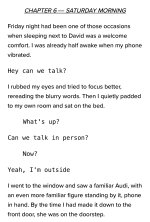
This is the markup underlying the example I posted above. It’s not that scary.


<p align="center"><em><u>CHAPTER 6 &mdash; SATURDAY MORNING</u></em></p>
Friday night had been one of those occasions when sleeping next to David was a welcome comfort. I was already half awake when my phone vibrated.

<kbd>Hey can we talk?</kbd>

I rubbed my eyes and tried to focus better, rereading the blurry words. Then I quietly padded to my own room and sat on the bed.
<blockquote><kbd>What’s up?</kbd></blockquote>
<kbd>Can we talk in person?</kbd>
<blockquote><kbd>Now?</kbd></blockquote>
<kbd>Yeah, I’m outside</kbd>

I went to the window and saw a familiar Audi, with an even more familiar figure standing by it, phone in hand. By the time I had made it down to the front door, she was on the doorstep.
 
It's not that bad (though maybe it's different depending on what platform you write in). I use a macro in Word to handle basic formatting, like the underlining. So I start by writing out the conversation:

And I don't touch it until I've finished the story or the chapter. Once I'm finished with content, I wrap everything in tags. Usually at this point I'll put pieces with lots of formatting, like texts, into a draft Lit story so I can preview just that portion of the text. Then I cut out the Word spacing and put in the line break tags. Then it goes back in the preview for a final check.

Trying to write it out with HTML included correctly as part of the first draft seems hard and intimidating, so I make it a separate step. It does put a little more of a burden on you to proofread your work closely and spend a bit more time than you otherwise might in the editing/proofing stage.
I'm sure it's one of those things that looks scary at first but makes a lot more sense if you put a bit of basic effort into learning it. It does look nice, so probably worth it. Might well try it out one day

This is the markup underlying the example I posted above. It’s not that scary.


<p align="center"><em><u>CHAPTER 6 &mdash; SATURDAY MORNING</u></em></p>
Friday night had been one of those occasions when sleeping next to David was a welcome comfort. I was already half awake when my phone vibrated.

<kbd>Hey can we talk?</kbd>

I rubbed my eyes and tried to focus better, rereading the blurry words. Then I quietly padded to my own room and sat on the bed.
<blockquote><kbd>What’s up?</kbd></blockquote>
<kbd>Can we talk in person?</kbd>
<blockquote><kbd>Now?</kbd></blockquote>
<kbd>Yeah, I’m outside</kbd>

I went to the window and saw a familiar Audi, with an even more familiar figure standing by it, phone in hand. By the time I had made it down to the front door, she was on the doorstep.
Thanks for the example. I think the kbd stuff does look pretty nice as well, will keep that in mind for the future
 
The <blockquote> or <p align…> is icing on the cake. Plain keyboard font is easy and you can manage convos easily enough with intervening text / reactions / my phone beeped and etc.
I do like the <blockquote> command, I used it in one of my stories to set off the writing on a plaque on a statue in one of my stories. I've been setting up the texts with it in several WIP's, just nothing published yet.

My only complaint with it is that its effect doesnt show up in the editing/preview process here. So if you mess the code, you can't catch it before it's published. So a writer has to be very careful with it.
 
My only complaint with it is that its effect doesnt show up in the editing/preview process here. So if you mess the code, you can't catch it before it's published. So a writer has to be very careful with it.
When it goes wrong, there's a risk it goes catastrophically wrong - like turn a whole Lit page to italics because you can't predict a page break and you didn't do a html closure at the end of a paragraph; or lose lines of dialogue completely, because you inadvertently created a command you didn't even know about.

- which is why I keep text designators really simple -
 
Wow this is a deja vu of a deja vu of a deja vu thread.
Code:
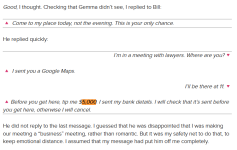
<i>Good</i>, I thought.   Checking that Gemma didn’t see, I replied to Bill:

<hr><p align=left>🔺<i> Come to my place today, not the evening. This is your only chance.</i></p><hr>
He replied quickly:

<hr><p align=right><i>I’m in a meeting with lawyers.  Where are you?</i>🔻</p>
<p align=left>🔺<i> I sent you a Google Maps.</i></p>
<p align=right><i>I’ll be there at 11.</i>🔻</p>
<p align=left>🔺<i>Before you get here, tip me $5,000. I sent my bank details. I will check that it’s sent before you get here, otherwise I will cancel.</i></p><hr>
He did not reply to the last message. I guessed that he was disappointed that I was making our meeting a “business” meeting, rather than romantic.  But it was my safety net to do that, to keep emotional distance. I assumed that my message had put him off me completely.
1765485122822.png
 
Hi everyone,

It's been a while since I published a story and I'm wondering what everyone is doing when inserting texts, DMs and other modern phone messages in their stories. How do you punctuate these correctly? Advice please!

There's not one "right" way, the idea is consistency. Pick a format and stick with it. I don't bother trying to make italics or bold work on this site. If you wanna try, go for it. I submit too many edits for it to be a good idea for me.

I just use something like this:

Witty: Text One
marriedpervs: Reply.
Witty: Response.

I've seen the >>> used before and that's a good one as well. Pick your favorite and don't change it is my advice.
 
Back
Top