Texts and DMs in stories - how to write them - inverted commas, italics? Advice please.

marriedpervs

Literotica Guru
Joined
Jan 24, 2004
Posts
8,853
Hi everyone,

It's been a while since I published a story and I'm wondering what everyone is doing when inserting texts, DMs and other modern phone messages in their stories. How do you punctuate these correctly? Advice please!
 
Many methods, many opinions.
I make sure the reader knows it is text by the words leading up to it (Her phone pinged with an incoming text from Bill.)

Then I put the texts in single quotation marks without describing the texters by keeping the messages brief and to the point. Also I try to use text-speak with appropriate abbreviations and shortcuts.

Others will give you very different suggestions.
 
I use square brackets in place of quotation marks to represent the bubble that texts appear in on a phone. I tried putting them on each line to create a complete bubble, but it looked terrible, so I went back to just the beginning and end of each message.

Next, I use the BR tag to force line breaks at the same character count as my own phone without creating a new paragraph.

Finally, I use p align="left" and p align="right" to put incoming on the left and outgoing on the right. You don't have to add the left alignment, as it's the default, but it makes it clear on future editing passes that I didn't just forget to add the right alignment to an outgoing text.

I don't think that I've used it in a published story yet, but I thought it looked good in the preview before I submitted it.
 
I don't think it's necessary to use a lot of formatting to designate text. All that's required is to tell the reader that what follows is an exchange of text messages, the reader can figure it out.

If it's obvious who the two texters are, I've started writing it as just text between quotes. Occasionally I'll break the string with some text, either the thoughts of one of the people, or the observations of another. That sort of "resets" the string of text messages so the reader doesn't bet confused.
 
I use single quotes most often, but in a text-message heavy story I switched to CAPS and a colon. E.g.:

ME: stuff

BECKY: other stuff

ME: third stuffs

I think it looks a little cleaner than the single quotes.
 
There are several ways to do it, and there's at least one other thread here about the subject. I write in Word and keep things simple. So in Word, it looks like this:
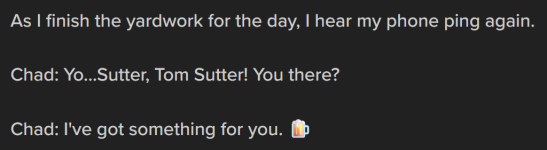
As I finish the yardwork for the day, I hear my phone ping again.


Chad: Yo…Sutter, Tom Sutter! You there?

Chad: I’ve got something for you. (beer emoji)

In the published story, it looks like this:

1765430995331.png

I have started using <blockquote> text </blockquote> in subsequent WIPs. This has the effect of pushing the texts over a bit, further dilenating them from the story. I just don't have a published example to show you at this time.
 
There are several ways to do it, and there's at least one other thread here about the subject. I write in Word and keep things simple. So in Word, it looks like this:


In the published story, it looks like this:

View attachment 2582682

I have started using <blockquote> text </blockquote> in subsequent WIPs. This has the effect of pushing the texts over a bit, further dilenating them from the story. I just don't have a published example to show you at this time.
Whoa is there a list of supported emojis? What the fuck I've never seen that, and I've been reading on here forever.
 
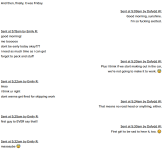
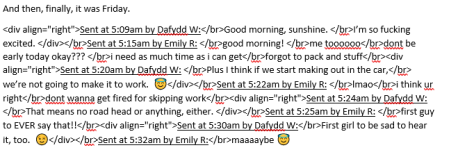
I use alternating right/left align plus </br> to put Sent messages on the right and Received messages on the left, and inserting manual line breaks to hopefully prevent them from running to the wrong side of the page. Here's how it ends up looking, and what it looks like in Word after I've put the HTML in. Edit: put my text in purple just to make it a lil easier to see what's screenshot and what's post.

1765431998181.png


1765432050141.png
 
I usually use this: >>

My phone pinged and I saw a text from Kim.

>>Hey babe, where are you?

>> At office. What’s up?
Careful with this - you might inadvertently create an unwanted html command. I used this format until I had a spectacular fail a couple of years ago, when I inadvertently created html, except I didn't know until an entire second page flipped to italics.

- ever since, I've kept it really simple, like this - EB texted a reply.
 

Quotations and Dialogue​


Q. How should text message conversations be styled within a story to distinguish them from normal dialogue? I already use italics for internal thoughts, and it might be confusing to use the same technique for text messages. I also use quotes with italics when a character is thinking about another person’s dialogue. Would reading a text message be akin to that? Or can I just make up something completely different (e.g., < how r u >)?

A. Unless a designer wants to create a special typography for text messages (as is sometimes done in books for children and young adults), just use quotation marks. It’s never been considered necessary to have a separate style for phone conversations, email, or other types of communication, and texts are nothing new in this regard. The context should make it clear: “how r u,” he texted; “ha ha Daddy I can’t believe you use ‘r u,’” she replied.

[This answer relies on the 17th edition of CMOS (2017) unless otherwise noted.]

I follow the above guidance from the Chicago style manual.

Here's an example from my own work:


My phone dinged. I picked it up quickly to find that a heart emoji had appeared on the photo, and the words: "you're in big trouble, Roz. You've made me postpone all my afternoon plans."

The text made me grin widely.

"So sorry, Lisette. I hope there's something I can do to make up for ruining your day 😇"

"In fact there is, you naughty girl," she texted back. "An eye for an eye."

My breath caught.

"What do you mean?"

"Where are you now?" she asked.

So I sent her a selfie and texted, "Jardin des Plantes."
 
@TheLobster I'm dying to know, what did I say to elicit the anger emoji?
I despise text messages being formatted as dialogue. They're not spoken, should not be formatted as such, and the snippet you gave is a great example why.

By the time one gets to the "speech tag," they have already interpreted the quoted text as having been spoken by the character. To learn than 'she texted back' is incredibly jarring.

As for my recommendation how to actually format messages, Emily above has the right idea; I usually do it this way. Ultimately, any other option -- like italics, names followed by a colon, fancy Unicode shenanigans -- works just fine, as long as it doesn't pretend to be spoken dialogue.
 
My two bits here is that even if you upload as a .docx, don't use <text message>. The system will interpret the brackets as as html tags and disappear the text.
 
I despise text messages being formatted as dialogue. They're not spoken, should not be formatted as such, and the snippet you gave is a great example why.

By the time one gets to the "speech tag," they have already interpreted the quoted text as having been spoken by the character. To learn than 'she texted back' is incredibly jarring.

As for my recommendation how to actually format messages, Emily above has the right idea; I usually do it this way. Ultimately, any other option -- like italics, names followed by a colon, fancy Unicode shenanigans -- works just fine, as long as it doesn't pretend to be spoken dialogue.
Noted, but I still stand by the suggestion.

I've never received negative feedback on my use of dialogue markers for text messages (save for yours), and some of the most authoritative manuals on style (e.g., CMOS) recommend it over other formats.
 
I will introduce them in text, then use - and bolding to indicate the content.

As in:

My phone buzzed and I pulled it out of my pocket.
-Hi, this is a text-
I responded quickly.
-So is this but from the POV character.-
 
Last edited:
Honestly, I think all that is more trouble than it's worth.

Just establish that it's a text then write it as a dialogue.

Fred checked his phone to find a message from Nancy.
"9 still good?"
He tapped a reply.
"Yes"
"See you then"

It's quick it's easy, you don't have to worry about some site hiccup ruining it, and it conveys the message.
 
Back
Top