Greedflation

Are Markups Driving the Ups and Downs of Inflation?

Federal Reserve Bank of San Francisco, May 13, 2024

How much impact have price markups for goods and services had on the recent surge and the subsequent decline of inflation? Since 2021, markups have risen substantially in a few industries such as motor vehicles and petroleum. However, aggregate markups—which are more relevant for overall inflation—have generally remained flat, in line with previous economic recoveries over the past three decades. These patterns suggest that markup fluctuations have not been a main driver of the ups and downs of inflation during the post-pandemic recovery.”

https://www.frbsf.org/research-and-...re-markups-driving-ups-and-downs-of-inflation

🙄

More gaslighting from BabyBoobs.

That article is an economic letter - an opinion piece.

BabyBoobs selected quote omits that little relevant tidbit.

Here - let me help:

“Opinions expressed in FRBSF Economic Letter do not necessarily reflect the views of the management of the Federal Reserve Bank of San Francisco or of the Board of Governors of the Federal Reserve System.”

😑

Hope that ^ helps.

👍

👉 BabyBoobs 🤣

🇺🇸
 
When did a gallon of bleach stop being a gallon of bleach?

And why is one jug of (no-name) bleach priced at a dollar while another jug (national brand) of the same size is priced over five dollars?
 
When did a gallon of bleach stop being a gallon of bleach?

And why is one jug of (no-name) bleach priced at a dollar while another jug (national brand) of the same size is priced over five dollars?
Different pricing from different suppliers. The so called 'greedflation' issue doesn't exist in a true free market. Customers will automatically gravitate towards cheaper products of equivalent quality, and suppliers will compete for customer business.
 
Different pricing from different suppliers. The so called 'greedflation' issue doesn't exist in a true free market. Customers will automatically gravitate towards cheaper products of equivalent quality, and suppliers will compete for customer business.
ITs not "so-called" greedflation. We know this is happening. A true free market is a thing that only actually interests criminals and can only be operated by criminals. Competition only lasts for a limited time in a free market especially in an increasingly shrinking world. It was never great but we've got years of deregulation that started under Reagan to show us exactly how bad a free market is and he didn't manage to take off all of the railing keeping us safe from the criminals. Hate to tell you but even if it might have been true in Ayn Rand's day (and I don't believe that it was) it certainly isn't true today that nothing could be important to mankind's survival could ever be remotely rare enough to be cornered by a few individuals.


https://fortune.com/2024/01/20/infl...-index-producer-price-index-corporate-profit/


Let me ask you something, adrina.

If the government decided tomorrow to give every citizen ten million dollars, boom, presto, the numbers are in everyone's bank account, what would happen to the economy?

Simple economic question, I'm curious if you can answer it.

In the magical world where every citizen gets ten million dollars a lot of things happen all at one, probably faster than the market could do a fucking thing about it. First for 90% of Americans that would instantly wipe out all debt period. It would be a complete clean slate on that front for basically anybody who isn't in the .1% or even higher than that. Feel free to find your own source, I literally chose the first one google gave me here. According Kiplinger the most expensive city in the nation. Manhattan has an average housing price of 2.7 million dollars. I hate math and will from this point forward call it 3 million.

So everybody with a mortgage is immediately out from under their mortgage.


https://www.kiplinger.com/real-estate/603612/15-us-cities-with-the-highest-average-home-prices

These are the ten most expensive "mass produced" cars in the world. Many of these are below 10 million and some are below seven so you could buy your place in Manhattan and a car to expensive for JAmes fucking Bond on that.

https://sothebysrealty.ae/the-journal/most-expensive-cars-in-the-world/

For the more realistic amongst us who don't need all of that we've still got millions to go around.

If you went to the single most expensive school in the world, Harvey Mudd which nobody has even heard of outside educational circles and. . .yeah you've paid off your debt and been done with that.

https://www.casita.com/blog/most-expensive-universities-in-the-world

I'm not gonna google what the average credit card debt is. I'm just gonna wager that very, very few people have a million or more in credit debt no matter how you twist it.

So US debt vanishes over night. Which sounds good until you remember that our entire economy is built on I owe you far more than any thing truly solid. Banks would have a hard time making money charging interest on loans nobody had so. . .that would kill loans but that's a tomorrow problem.

Imediately after that there will be a very, very interesting period of inflation that nobody can predict because nobody has ever actually seen anything realistically like this. The price of plenty of things would start going on up and quickly and some at least in the short term would remain somewhat static. I'm not gonna buy more ice cream than I can store just because I can. This wouldn't be the Trump Toileit Paper Wars. I lost a dear friend in that conflict. He was beaten to death by an octogenarian with osteroperosis and a walker. I still remember the streaks of blood from her tennis balls as she triumphantly left Office Max with the last Bounty Paper towels. I don't even know why Office Max had them. I was forced to crap right before showers and just shower after every shit. They were dark times.

IT would be impossible to predict this phase.

Eventually it would level out one way or another but it would be one helluva ride in. However this is a stupid question. Why not ask what happens to the economy if we wake up tomorrow and 99% of Americans are born with unique powers called quirks which range from powers as stupid as producing chocolate salty balls to being able to blast fire and ice from your finger tips. However people without powers are ostracized and useless. ITs far more realistic.
 
So tell me again, libs, how there's a solution that doesn't involve revolutionary expropriation?

(and, preferably, guillotines)
 
Different pricing from different suppliers. The so called 'greedflation' issue doesn't exist in a true free market. Customers will automatically gravitate towards cheaper products of equivalent quality, and suppliers will compete for customer business.
:LOL: This guy, this guy here! :LOL::LOL::LOL:

"Suppliers" will collude and agree to continue the exploitation of the lower classes as thoroughly as possible. You don't get a say in the cost or quality of your product when absolutely everyone is making progressively shittier products and their total control of the economy means that no interloper will ever disrupt the cartel.

For all that like to say that there's no such thing as AES (actually existing socialism), I would like to see a single case of the "free market" working like how conservatives seem to think it should work.
 
Thank you. That is a very prominent, and not uncommon, example of absolutely zero understanding of economics.

I'll be curious to see if anyone else here is interested in explaining why.

It has been shown in the past. I've been studying economics in depth for two decades. Nobody will explain why it shows no understanding of economics because it does not. That's actually why your pawning it off.
 
Poor Laz is really grasping at straws. I shared research published this month by economists at the Federal Reserve Bank of San Francisco. He responded with an opinion piece published in a political media outlet written by a progressive sociologist named Lindsay Owens, “She/Her.”

She’s Executive Director of a left wing political advocacy group called the “Groundwork Collaborative” and before that was a staffer for three of the most extreme left wing politicians in DC, including Senator Elizabeth Warren, Rep. Keith Ellison, and Rep. Pramila Jayapal. Her under graduate and graduate degrees are in Political Science and Sociology. She has no formal education in the field in economics and no business experience.

Her opinion piece is pure fluff. To support her misleading claim that corporate profits have “soared to 70 year highs”, she links to an article in Business Insider. The metric cited in that is “US nonfinancial corporate profit margin” rather than conventional profit margin metrics which show profits were actually higher in Q1 of 2012 than Q4 2023.

The Federal Reserve Board of Governors defines the non financial measure and explains what it tells us about post-pandemic corporate profit margins:

But were corporate profit margins abnormally high in the aftermath of the COVID-19 pandemic? The answer depends on measurement. Using a measure of nonfinancial corporate profits from the national income accounts–before tax profits with capital consumption adjustment–we find that nonfinancial corporate profit margins, or profits over gross value added, increased sharply to about 19% in 2021q2 and slipped back to 15% in 2022q4, compared to about 13% in 2019q4. This contrasts sharply with the steep dive in margins that normally occurs during a severe economic contraction.

Our analysis shows that much of the increase in aggregate profit margins following the COVID-19 pandemic can be attributed to (i) the unprecedented large and direct government intervention to support U.S. small and medium sized businesses and (ii) a large reduction in net interest expenses due to accommodative monetary policy. Once we adjust for fiscal and monetary interventions, the behavior of aggregate profit margins appears much less notable, and by the end of 2022 they are essentially back at their pre-pandemic levels.


The Fed - Corporate Profits in the aftermath of COVID-19
 
It has been shown in the past. I've been studying economics in depth for two decades. Nobody will explain why it shows no understanding of economics because it does not. That's actually why your pawning it off.
If you had the faintest clue about economics, you would've simply pointed out my scenario would lead to complete economic and societal collapse overnight. That's the only outcome, period.

But sure, you understand and studied economics. 🤣
 
Tax cuts for the rich have become the universal Republican panacea. I am old enough to remember when Republicans valued balanced budgets. What happened?
 
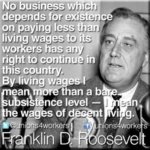
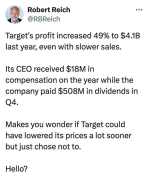
Duh...Corporate America and their CEOs don't give a single damn about you or any other consumer beyond getting you to buy whatever shit they are selling. CEOs compensation grows by leaps and bounds and the actual workers salaries stagnate. It isn't that people don't want to work, it's that they don't want to work 2 or 3 jobs to make ends meet. If you can afford to pay CEOs millions you can afford to pay workers a true living wage. I blame the federal government for this too. The minimum wage has been set at $7.25 since 2009. That is insane. You can't rent a place to live, buy a car, feed your family, or afford medical care on $290.00 a week. Minimum wage should be somewhere in the $11.00 to $15.00 an hour range. The only reason that would make prices go up is once again corporate greed. Why are we okay with CEOs making millions while their workers are on food stamps?

Roosevelt.jpg
 
Poor Laz is really grasping at straws. I shared research published this month by economists at the Federal Reserve Bank of San Francisco. He responded with an opinion piece published in a political media outlet written by a progressive sociologist named Lindsay Owens, “She/Her.”

She’s Executive Director of a left wing political advocacy group called the “Groundwork Collaborative” and before that was a staffer for three of the most extreme left wing politicians in DC, including Senator Elizabeth Warren, Rep. Keith Ellison, and Rep. Pramila Jayapal. Her under graduate and graduate degrees are in Political Science and Sociology. She has no formal education in the field in economics and no business experience.

Her opinion piece is pure fluff. To support her misleading claim that corporate profits have “soared to 70 year highs”, she links to an article in Business Insider. The metric cited in that is “US nonfinancial corporate profit margin” rather than conventional profit margin metrics which show profits were actually higher in Q1 of 2012 than Q4 2023.

The Federal Reserve Board of Governors defines the non financial measure and explains what it tells us about post-pandemic corporate profit margins:

But were corporate profit margins abnormally high in the aftermath of the COVID-19 pandemic? The answer depends on measurement. Using a measure of nonfinancial corporate profits from the national income accounts–before tax profits with capital consumption adjustment–we find that nonfinancial corporate profit margins, or profits over gross value added, increased sharply to about 19% in 2021q2 and slipped back to 15% in 2022q4, compared to about 13% in 2019q4. This contrasts sharply with the steep dive in margins that normally occurs during a severe economic contraction.

Our analysis shows that much of the increase in aggregate profit margins following the COVID-19 pandemic can be attributed to (i) the unprecedented large and direct government intervention to support U.S. small and medium sized businesses and (ii) a large reduction in net interest expenses due to accommodative monetary policy. Once we adjust for fiscal and monetary interventions, the behavior of aggregate profit margins appears much less notable, and by the end of 2022 they are essentially back at their pre-pandemic levels.


The Fed - Corporate Profits in the aftermath of COVID-19

🙄

"The Fed" also said this:

https://www.kansascityfed.org/resea...rate-profits-contributed-to-recent-inflation/

😑

👉 BabyBoobs 🤣

🇺🇸

Side note:

This is a good read that is directly related to "Greedflation” (Seller’s Inflation): and how it can be / is being addressed:

https://www.newyorker.com/news/persons-of-interest/what-if-were-thinking-about-inflation-all-wrong

👍

🇺🇸
 
What's the answer here?


We don't want price controls.

We don't want higher taxes, even on 'the rich'.

We don't want to control salary or pay/compensation packages.

We don't really have much price competition or choices of companies to deal with as indicated by the mega mergers, so we can't really shop with our feet.


What DO we want?
 
What's the answer here?


We don't want price controls.

We don't want higher taxes, even on 'the rich'.

We don't want to control salary or pay/compensation packages.

We don't really have much price competition or choices of companies to deal with as indicated by the mega mergers, so we can't really shop with our feet.


What DO we want?

The wealthy and corporations are “The Borg”.

“Resistance is futile”.

🙄

😳

😑

👉 BabyBoobs 🤣

🇺🇸
 
What's the answer here?


We don't want price controls.

We don't want higher taxes, even on 'the rich'.

We don't want to control salary or pay/compensation packages.

We don't really have much price competition or choices of companies to deal with as indicated by the mega mergers, so we can't really shop with our feet.


What DO we want?

Actually the majority of Americans, by a healthy percentage, want increased taxes on the rich/corporations.

One very real solution that we really do need to revisit is trust busting. We have a small handful of companies at the top of every industry. Collusion is more likely than competition.
 
FTC is trying to deal with a few of the mega companies, but they have a bumpy road with Congress and the Courts.

But these mergers should never have been allowed to begin with. The ones listed above need to be stopped.
 
What's the answer here?


We don't want price controls.

We don't want higher taxes, even on 'the rich'.

We don't want to control salary or pay/compensation packages.

We don't really have much price competition or choices of companies to deal with as indicated by the mega mergers, so we can't really shop with our feet.


What DO we want?

On a serious note, read this:

https://www.newyorker.com/news/persons-of-interest/what-if-were-thinking-about-inflation-all-wrong

🤔

There IS hope… maybe…

👍

🇺🇸
 
🙄

"The Fed" also said this:

https://www.kansascityfed.org/resea...rate-profits-contributed-to-recent-inflation/

😑

👉 BabyBoobs 🤣

🇺🇸

Side note:

This is a good read that is directly related to "Greedflation” (Seller’s Inflation): and how it can be / is being addressed:

https://www.newyorker.com/news/persons-of-interest/what-if-were-thinking-about-inflation-all-wrong

👍

🇺🇸
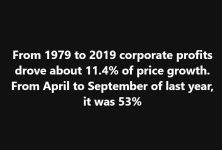
The article says “markups could account for more than half of 2021 inflation” (with a big caveat). Now do 2022, 2023, and 2024.

Andrew Glover, José Mustre-del-Río, and Alice von Ende-Becker present evidence that markup growth was a major contributor to inflation in 2021. Specifically, markups grew by 3.4 percent over the year, whereas inflation, as measured by the price index for Personal Consumption Expenditures, was 5.8 percent, suggesting that markups could account for more than half of 2021 inflation. However, the timing and cross-industry patterns of markup growth are more consistent with firms raising prices in anticipation of future cost increases, rather than an increase in monopoly power or higher demand.
 
Personally I DO want regulations on corporate pay packages. Something like not more than X% of the employee payroll, or tied to the average employee wage somehow. Suits only get a raise if the workers do.
 
Personally I DO want regulations on corporate pay packages. Something like not more than X% of the employee payroll, or tied to the average employee wage somehow. Suits only get a raise if the workers do.
Sounds an awesome motivation to not hire workers and instead push out further and faster automation.
 
Back
Top