Navigation
Install the app
How to install the app on iOS
Follow along with the video below to see how to install our site as a web app on your home screen.
Note: This feature may not be available in some browsers.
More options
You are using an out of date browser. It may not display this or other websites correctly.
You should upgrade or use an alternative browser.
You should upgrade or use an alternative browser.
Second Person
- Thread starter TarnishedPenny
- Start date

Bubo_bubo
Virgin
- Joined
- Jul 24, 2022
- Posts
- 998
https://i.pinimg.com/originals/4a/06/ef/4a06efb5a2f39feaa2f81b9f3d179a94.gifSecond person is strict. If the narrator is first person, the work is first person, not second.

Voboy
Sometime Wordwright
- Joined
- Mar 21, 2016
- Posts
- 7,359
I think another way to use second person is not as the primary point of view, but as a sort of Dear Reader, address, which works best if the narrator is first person and some kind of identifiable character telling you a story in which they might not even be the main character.
"And you, Dear Reader, what do you think happened next? Well, I doubt you predicted this." - kind of thing.
This is first person, though...

KeithD
Virgin
- Joined
- Jan 14, 2012
- Posts
- 29,626
Your confusion on this is your problem.
Bubo_bubo
Virgin
- Joined
- Jul 24, 2022
- Posts
- 998
Yes. That is what I say. In the text you quote. "if the narrator is first person".This is first person, though...
Bubo_bubo
Virgin
- Joined
- Jul 24, 2022
- Posts
- 998
I don't know what category your stories are in, but your posts seem to belong mostly in the "Anal" category.Your confusion on this is your problem.
KeithD
Virgin
- Joined
- Jan 14, 2012
- Posts
- 29,626
Again, your issue is yours alone. Attacking me for giving you writing guidance when you were off the beam doesn't impress me. I'm not the only one who told you you were off the beam. Perhaps you should stick with what you actually know.I don't know what category your stories are in, but your posts seem to belong mostly in the "Anal" category.

Bramblethorn
Sleep-deprived
- Joined
- Feb 16, 2012
- Posts
- 19,598
Charles Stross's "Halting State" is an example. It switches between three different second-person viewpoints. By my understanding he was aiming to evoke that CHYOA/RPG feeling.Call me dim, but could you give me an example of writing in the second person?
The only use I can think of is those Adventure/Fantasy books you read when you're young.
Bramblethorn
Sleep-deprived
- Joined
- Feb 16, 2012
- Posts
- 19,598
There's a distinction between specific "you" ("you are AlinaX", "my fellow Americans, you should vote for me") and generic "you" ("everybody knows you shouldn't argue with people on the Internet", "you don't simply walk into Mordor").You would think that writing in second person was impossible. You would think that even if it were possible, it could not be erotic. You would think, were you to read Literotica extensively that there is no true second person, there is only first person with weird telepathy and hypotheticals sprinkled in. Or maybe you would argue that the only good use for second person is in interactive fiction, where you are given the choice to go this way, or that way, or, indeed, to quit while you're ahead and go get a life.
But you would be wrong. You know that second person is possible, and you know that it can be erotic. You know this because the conversation in the forum loops around like Groundhog Day, which you must have watched a hundred times - and there's all those derivatives too, like Before I Fall, or that one episode in every long-running TV series from Dr Who to Xena: Warrior Princess.
You know, but you would rather argue that it has never been done, and therefore that it can't.
You know.
Most of the stories that prompt these discussions are using specific "you". There seems to be disagreement about whether generic "you" is in fact second person; I've seen it referred to as fourth in some places.
Attachments


ElectricBlue
Somewhat Nostalgic
- Joined
- May 10, 2014
- Posts
- 20,483
I find second person (eg: AlinaX's story, linked above) really odd, really alienating. Firstly, there's the gender problem (telling me I'm female when I'm not); telling me I'm doing things when I'm not; and telling me what I'm doing when, even if I was so inclined to do it, I'd not do it because I don't like being told what to do by someone whose authority I don't accept. It takes away all agency (which is why, perhaps, there are some people who like it).
It becomes so remote - for me, the exact opposite of intimacy.
It becomes so remote - for me, the exact opposite of intimacy.

XerXesXu
Virgin' on literate.
- Joined
- Oct 18, 2011
- Posts
- 2,194
You could use 'you' as opposed to 'one' - the impersonal personal pronoun, to draw that distinction.There's a distinction between specific "you" ("you are AlinaX", "my fellow Americans, you should vote for me") and generic "you" ("everybody knows you shouldn't argue with people on the Internet", "you don't simply walk into Mordor").
Most of the stories that prompt these discussions are using specific "you". There seems to be disagreement about whether generic "you" is in fact second person; I've seen it referred to as fourth in some places.
(That should have been 'One can use ....'.)
Last edited:

MrPixel
Just a Regular Guy
- Joined
- May 12, 2020
- Posts
- 7,277
You are in a room with three doors and a window. You discover that all the doors are locked. You try the window, which opens with little effort. You assume this is your escape and you jump out.
*SPLAT*
GAME OVER.
I find second person beyond annoying because all it does is remind me of the online D&D games we'd play on the teletypes at school when we should have been entering lab data.
*SPLAT*
GAME OVER.
I find second person beyond annoying because all it does is remind me of the online D&D games we'd play on the teletypes at school when we should have been entering lab data.
Bramblethorn
Sleep-deprived
- Joined
- Feb 16, 2012
- Posts
- 19,598
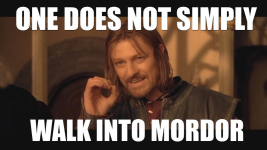
Indeed. Sadly the impersonal "one" seems to be drifting out of fashion, but I was referring to this meme/quote there:You could use 'you' as opposed to 'one' - the impersonal personal pronoun, to draw that distinction.
(That should have been 'One can use ....'.)
Bramblethorn
Sleep-deprived
- Joined
- Feb 16, 2012
- Posts
- 19,598
Interesting example. We could argue about whether it's second or first person, depending on whether Bill counts as a person in the "story" he's telling - he never directly refers to himself but his presence is implied in things like "it gets the hose". Even if we do call it first person, though, I think it's still relevant to second-person storytelling.How about a slightly different sense of how second person works?
In this scene, Bill is asserting power - he's telling somebody else what they will do, depriving them of choice (compounded by dehumanising use of "it").
This is also the main reason why people tend to dislike second-person narrative: the author is making choices for them. The resolution to that is either to restore choice (e.g. the CHYOA approach) or to use it in a story where that deprivation of choice becomes a positive - e.g. for a reader who wants to imagine themselves as the submissive in a BDSM scene, or the victim in a NC/MC situation.
I've encountered a couple of different CHYOA-style stories/games where choices turned out to be illusory. In one of them, it was just annoying and bad writing: an established writer was trying out interactive fiction more or less as a gimmick, and hadn't bothered adapting to the medium. So they'd just written a single storyline, and then added meaningless choices: if you turn left you go to page 12, if you turn right you go to page 35, but both page 12 and page 35 then steer back to page 55, that kind of thing.
The other was The Day The Laughter Stopped. It's more powerful if played blind, but it does also have high-level triggery content described here so for people who need to be careful around that kind of content it's probably better avoided. In that one, it was a very effective way of making a point about how people can get blamed for "choices" which weren't actually meaningful choices.
Hmm, I just noticed TDTLS has stats on player choices: https://hypnoticowl.com/theday/stats/ There are points in the game where the player is offered options, but some of the options don't respond (the protagonist is freezing up). It has numbers on how often players tried to choose the disabled "good" options before giving in to the bad "choice". Maybe it's just me, but knowing what those choices are in the game, those numbers are kind of powerful in their own right.
Last edited:

SimonDoom
Kink Lord
- Joined
- Apr 9, 2015
- Posts
- 22,002
I don't discourage people from trying to use it if they want to, but the inherent problem with "you" as a fictional point of view, as I see it, is that it necessarily implies, based upon how it's ordinarily used, the existence of an "I." The second-person point of view typically is used when one person is addressing another. In fiction, this gives rise to an inherent difficulty: how does "I" know what "you" is thinking? Even if you completely rid your story of all visible presence of the "I," the "I" is still there, based upon what using "you" is all about in the first place.
There's also the odd feeling, when reading a story in this POV, that I'm being referred to by the narrator, but "I" am not the "you" of the story. The narrator is addressing me but describing another person. I'm constantly asking, "Why would one do that? You don't know me, and I'm not the character you are telling me about." There's a completely unnecessary narrative substructure with second-person POV that does not exist when you use first-person POV or third-person POV.
There's also the odd feeling, when reading a story in this POV, that I'm being referred to by the narrator, but "I" am not the "you" of the story. The narrator is addressing me but describing another person. I'm constantly asking, "Why would one do that? You don't know me, and I'm not the character you are telling me about." There's a completely unnecessary narrative substructure with second-person POV that does not exist when you use first-person POV or third-person POV.

AlinaX
Sometimes Alien
- Joined
- Feb 1, 2014
- Posts
- 5,618
With third person, the reader is merely an observer of events, and is free to disagree with conclusions drawn and actions taken. With first person, this is mostly true, but there's a stronger connection with the narrator. In both cases, however, it's easy to think of it as a story being told, and the reader is an observer who can identify or not with the various characters.
Second person is radically different. The reader cannot be a mere observer, and maybe it does require a degree of submissiveness or dissociation from the reader: This is who you are. This is what you do. Certainly it creates an atmosphere of being out of control of events.
I'm not a fan of second person. (Certainly I'm not of pseudo-second.) But it can be used effectively and even erotically, and as a technical challenge for authors it can be very instructive.
Second person is radically different. The reader cannot be a mere observer, and maybe it does require a degree of submissiveness or dissociation from the reader: This is who you are. This is what you do. Certainly it creates an atmosphere of being out of control of events.
I'm not a fan of second person. (Certainly I'm not of pseudo-second.) But it can be used effectively and even erotically, and as a technical challenge for authors it can be very instructive.

nylonpunkie
Experienced
- Joined
- Oct 29, 2019
- Posts
- 95
FunnyI don't know what category your stories are in, but your posts seem to belong mostly in the "Anal" category.
Made me chuckle.
KeithD
Virgin
- Joined
- Jan 14, 2012
- Posts
- 29,626
If he'd bothered to check my primary genre, which would have been easy to do, he (and you) would know there isn't much sting to that jab. Pretty much identifies him as the butt hurt one.Funny
Similar threads

- Replies
- 112
- Views
- 3K


- Replies
- 45
- Views
- 978


- Replies
- 87
- Views
- 3K


Share: