
Actingup
Mostly Harmless
- Joined
- Feb 12, 2018
- Posts
- 2,136
Righto, following my earlier threads looking at the difference between percentile scores in Loving Wives and between 2025 and 2024 generally, I've done a deep dive into a dozen Literotica story categories and how they scored during 2025. I used the same method described earlier - in brief, this uses a score sorted search retrieval of stories and then a calculation of story percentiles (the 1st, 5th, 10th....90th, 95, and 99th score percentiles in the category). So, if a story has a percentile of 50 (the median), half the stories in the category are above it, and half below. If the story has a percentile of 99, only 1% of the stories in the category are above it. If the story has a percentile of 1... well, you're not reading this post anyway.
So, let's start with a table of results. Although it's only a dozen categories, these 44048 stories cover 66% of the published stories in the past 12 months - if you're interested in other categories, sorry, but you might have to calculate the stats yourself unless you can convince me that another category would be particularly interesting to look at.

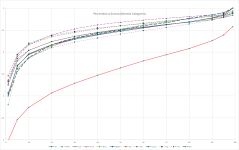
For ease of reference, I've marked every score of 4.5 or above in red so that you can see what's 'HOT'. So, for example, you can be hot in Sci-Fi with a 28% percentile or above (everybody gets a prize!), but to be hot in Loving Wives, you need about a 97.5 percentile (he says smugly). Similiarly, gay and lesbian story readers are kinder than reluctance/non-consent readers (who knew!?).
Let's graph that out:
and because nearly everything is clustered together, let's zoom in to the upper range:
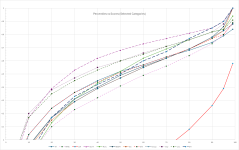 Sorry the graphs are rather messy - you can see why I stopped after a dozen categories. There are probably lots of little comments to make about the way that the categories compare, but I'll spare you any more snark about one versus the other - they are simply different.
What can we take from this? Well, to re-state the obvious, our story scores are not an absolute measure of quality, and particularly should not be compared across categories unless you're aware that voter scoring behaviour is not consistent. Even if you exclude the hard arses of LW readers, there's still a difference of nearly 0.3 between the median R/NC and Sci-Fi scores, and that is significant. If you're posting in a hard-marking category, you could use this as a measure of comfort. If you're posting in an easier category, use this to stay humble. And I think that many of us could stand to remember that the 'Hot' rating is not that significant or important. As stated many times, LW readers (for example) will give you masses of reads and comments even if they are scoring your story harder. Scores are not a measure of engagement, and they don't necessarily drive engagement in an absolute sense.
The analysis might also be useful if you publish across these categories and you'd like to look at what readers thought of your stories using a more subtle scoring mechanism. I now have evidence, for example, that my top rated stories in percentile terms are in LW and T/I rather than in Romance (where my top scoring stories are). I know that, as suspected, Group Sex is a little tougher other categories, and I can forgive myself for not being so spectacular there (er, I mean in terms of the stories of course). I also know that my resentment at Erotic Horror readers for not recognising my genius is maybe a bit unfair, since they clearly do reward good stories.
Oh, and I think that this stuff is more meaningful than the much contested top lists, too. If you're in the top few % in your category, you're in the big league without needing to be at the top of the pile.
Comments welcome!
So, let's start with a table of results. Although it's only a dozen categories, these 44048 stories cover 66% of the published stories in the past 12 months - if you're interested in other categories, sorry, but you might have to calculate the stats yourself unless you can convince me that another category would be particularly interesting to look at.
For ease of reference, I've marked every score of 4.5 or above in red so that you can see what's 'HOT'. So, for example, you can be hot in Sci-Fi with a 28% percentile or above (everybody gets a prize!), but to be hot in Loving Wives, you need about a 97.5 percentile (he says smugly). Similiarly, gay and lesbian story readers are kinder than reluctance/non-consent readers (who knew!?).
Let's graph that out:
and because nearly everything is clustered together, let's zoom in to the upper range:
Sorry the graphs are rather messy - you can see why I stopped after a dozen categories. There are probably lots of little comments to make about the way that the categories compare, but I'll spare you any more snark about one versus the other - they are simply different.What can we take from this? Well, to re-state the obvious, our story scores are not an absolute measure of quality, and particularly should not be compared across categories unless you're aware that voter scoring behaviour is not consistent. Even if you exclude the hard arses of LW readers, there's still a difference of nearly 0.3 between the median R/NC and Sci-Fi scores, and that is significant. If you're posting in a hard-marking category, you could use this as a measure of comfort. If you're posting in an easier category, use this to stay humble. And I think that many of us could stand to remember that the 'Hot' rating is not that significant or important. As stated many times, LW readers (for example) will give you masses of reads and comments even if they are scoring your story harder. Scores are not a measure of engagement, and they don't necessarily drive engagement in an absolute sense.
The analysis might also be useful if you publish across these categories and you'd like to look at what readers thought of your stories using a more subtle scoring mechanism. I now have evidence, for example, that my top rated stories in percentile terms are in LW and T/I rather than in Romance (where my top scoring stories are). I know that, as suspected, Group Sex is a little tougher other categories, and I can forgive myself for not being so spectacular there (er, I mean in terms of the stories of course). I also know that my resentment at Erotic Horror readers for not recognising my genius is maybe a bit unfair, since they clearly do reward good stories.
Oh, and I think that this stuff is more meaningful than the much contested top lists, too. If you're in the top few % in your category, you're in the big league without needing to be at the top of the pile.
Comments welcome!
Last edited:


