Housing

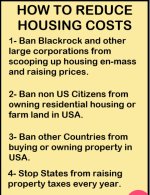
A few articles from different perspectives on the housing issue. There are a few moving parts that are difficult to.mesh together given the current policies by the federal government on trade and people. Local zoning doesn't help in some cases since some say NIMBY. Material costs due to their sources and tariffs hurt. Some skilled laborers are no longer in the country. Eventually more of these effects will be felt in GDP and small, flat or negative growth. Time will tell.

https://www.nahb.org/advocacy/top-p...bility-crisis/housing-affordability-blueprint

https://www.forbes.com/sites/jeffst...ative-solutions-to-affordable-housing-crisis/

https://www.pew.org/en/research-and...licies-to-help-curb-housing-costs-immediately
 
Rising house prices are not good for anyone outside the real-estate business. You are part of that business.
that is true. sorry, I'm running out of steam as it's been a very long day.

where I have most of my assets is a market not for families. They've been priced out of these markets
 
Think twice before buying a new house from a big corporate builder. Their standards could be shit, and they have the clout to get shoddy work past building inspectors.

 
well there are dark sides to housing

Cabrini Green in Chicago being the darkest.

In the name of Urban Renewal the racist white Democrats running Chicago bulldozed a vibrant low-income black neighborhood. In doing so they obliterated the local businesses that provided entry-level jobs to working class black men. They obliterated the important social hubs like churches, bars, and barbershops where much of the civil rights movement was being organized.

In the end the racist white Democrats running Chicago transformed a vibrant neighborhood into a violent, drug infested, gang infested ghetto. But where this attack on rising black political power succeeded then I suppose the racist white Democrats won what they wanted: political power for the Daley Machine.

In the end what happened to Cabrini Green? This monument to a racist Democrat experiment in socialism was destroyed.

https://www.chicagotribune.com/2020...kers-to-good-times-jane-byrne-and-demolition/
 
Cabrini Green in Chicago being the darkest.

In the name of Urban Renewal the racist white Democrats running Chicago bulldozed a vibrant low-income black neighborhood. In doing so they obliterated the local businesses that provided entry-level jobs to working class black men. They obliterated the important social hubs like churches, bars, and barbershops where much of the civil rights movement was being organized.

In the end the racist white Democrats running Chicago transformed a vibrant neighborhood into a violent, drug infested, gang infested ghetto. But where this attack on rising black political power succeeded then I suppose the racist white Democrats won what they wanted: political power for the Daley Machine.

In the end what happened to Cabrini Green? This monument to a racist Democrat experiment in socialism was destroyed.

https://www.chicagotribune.com/2020...kers-to-good-times-jane-byrne-and-demolition/
As I recall, the thinking behind that kind of project was that blacks living in TOWERS could not RIOT.
 
Cabrini Green in Chicago being the darkest.

In the name of Urban Renewal the racist white Democrats running Chicago bulldozed a vibrant low-income black neighborhood. In doing so they obliterated the local businesses that provided entry-level jobs to working class black men. They obliterated the important social hubs like churches, bars, and barbershops where much of the civil rights movement was being organized.

In the end the racist white Democrats running Chicago transformed a vibrant neighborhood into a violent, drug infested, gang infested ghetto. But where this attack on rising black political power succeeded then I suppose the racist white Democrats won what they wanted: political power for the Daley Machine.

In the end what happened to Cabrini Green? This monument to a racist Democrat experiment in socialism was destroyed.

https://www.chicagotribune.com/2020...kers-to-good-times-jane-byrne-and-demolition/

Urban Renewal projects happened the same way all across the nation. It had nothing to do with Democrats or Republicans.

But please continue your uninformed rants. They’re funny. 👍
 
So long as Capital Gains on Property are taxed more leniently than incomes, property price inflation will increase at levels tending greater than general inflation. Part of the solution is an increase in the taxation of capital gains. Unpopular but necessary.
 
Urban Renewal projects happened the same way all across the nation. It had nothing to do with Democrats or Republicans.

But please continue your uninformed rants. They’re funny. 👍

From Google:

Democratic-led urban renewal, particularly from the 1950s–1970s, used federal funding for "slum clearance" to modernize cities, often displacing minority communities and benefiting private developers. While intended to improve housing, these liberal-backed projects became known as "negro removal," causing lasting racial division. Modern Democrats now focus on equity-based reinvestment and transit-oriented development to correct these past harms.

Historical Role (1950s-1970s)
  • The Liberal Push: Urban renewal was championed by liberal progressives like Edward Logue, who saw federal intervention as necessary to save cities, modeled on New Deal principles.
  • Consequences: Democratic-led federal policy (via HUD) often used eminent domain to clear older, low-income neighborhoods, transferring land to private developers. This resulted in the destruction of housing and communities, with critics calling it "negro removal".
  • Policy Shift: By the 1970s, this top-down approach face backlash, pulling Democrats toward balancing development with community input and environmental concerns.
    (Shelterforce)
Modern Democratic Urban Policy
  • Reparation and Equity: Current Democratic approaches focus on reversing the harms of previous decades, often emphasizing community-led planning and addressing racial disparities caused by past projects, such as freeway construction.
  • Neighborhood Access and Equity: In 2023, a Democratic Congress created programs aimed at converting old highways into pedestrian-friendly areas, focusing on equity.
  • Housing Affordability: Modern Democratic strategies prioritize "building up" rather than just replacing "blight," focusing on housing supply, sustainability, and density.
    (E&E News by POLITICO)
Criticisms and Challenges
  • "Urban Growth Machine": Critics allege that even with social goals, Democratic housing policies frequently align with real estate interests to create, rather than solve, affordability issues, which has led to intense internal debates on the left.
  • Profit vs. Need: Modern efforts often struggle to balance private development incentives with the need for low-income, affordable housing.
    (Shelterforce)

 
Urban Renewal projects happened the same way all across the nation. It had nothing to do with Democrats or Republicans.

But please continue your uninformed rants. They’re funny. 👍

Also, ignorance of history on your part is not a shortcoming on my part.
 
So long as Capital Gains on Property are taxed more leniently than incomes, property price inflation will increase at levels tending greater than general inflation. Part of the solution is an increase in the taxation of capital gains. Unpopular but necessary.
CUTTING the capital gains tax has been an issue before, but I always understood it to involve gains on securities, not real estate.
 
Also, ignorance of history on your part is not a shortcoming on my part.

iGnoRanCe oF hiStoRy

Urban Renewal projects happened the same way all across the nation. It had nothing to do with Democrats or Republicans.

Pick any city that had a Republican mayor at the time and I’ll list their urban renewal projects. 👍
 
From Google:

Democratic-led urban renewal, particularly from the 1950s–1970s, used federal funding for "slum clearance" to modernize cities, often displacing minority communities and benefiting private developers. While intended to improve housing, these liberal-backed projects became known as "negro removal," causing lasting racial division. Modern Democrats now focus on equity-based reinvestment and transit-oriented development to correct these past harms.

To demonstrate how AI responses are sensitive to how you phrase a question: 👍

During the 1960s, urban renewal projects were largely driven by federal funding (via the Housing Acts of 1949 and 1954, later expanded in 1965) and were implemented by local governments, regardless of the party affiliation of the mayor. While many major cities had Democratic machines, several cities with Republican mayors or pro-growth Republican business coalitions aggressively pursued these projects, often focusing on "slum clearance," highway construction, and downtown "revitalization" that resulted in significant displacement of minority communities.

Here are urban renewal projects and initiatives associated with cities that had Republican mayors or prominent Republican business leadership in the 1960s:
  • New York City (John Lindsay, elected 1965):
    • Lower Manhattan Expressway (LOMEX):Although ultimately defeated by protests led by Jane Jacobs, the project was a major focus of urban planners and the administration.
    • South Bronx Redevelopment: Led by Ed Logue, the city focused on constructing industrial parks near the Cross Bronx Expressway, which involved the demolition of abandoned buildings.
    • Brooklyn & Harlem: Continued development of urban renewal projects, including the work of the Architects' Renewal Committee in Harlem (ARCH).
  • Indianapolis (Richard Lugar, elected 1967/1968):
    • Unigov and Downtown Redevelopment: While his major restructuring occurred at the turn of the decade, Lugar's administration (starting in 1968) initiated ambitious downtown redevelopment plans that accelerated through the 1970s, focused on creating a "sports mecca" and revitalizing the business district.
  • Champaign-Urbana, Illinois (Mayor Emmerson Dexter, 1960s):
    • North End Urban Renewal: Initiated in 1960, this project involved the city council and planners in extensive debate over code enforcement and the concentration of public housing in the North End, a predominantly Black area.
These projects often resulted in the destruction of low-income neighborhoods, with the 1960s marking the shift from merely clearing slums to "rehabilitation" and, eventually, a rise in protest against "urban renewal" being "Negro removal".
 
Back
Top