2-4% of people have Aphantasia (No visual imigery)

Yes, that's where it's very visible. Hubby now understands that he can't say "turn left after the bridge." I say, "What bridge?" (Bridges you drive over a river, not big, big bridges... those warrant a mental note.)

I still have to stop and think hard about various complicated turns in our neighborhood. East coast, where cows laid out the streets.

We joke that if I get lost I'd just drive until I hit the circumference road around our city, and then I'd find a familiar exit and go from there.
I can't even imagine.
Do you take a lot of pictures then, to have a reference for memories?
 
I can't even imagine.
Do you take a lot of pictures then, to have a reference for memories?
No. It's not that we don't recognize things we've seen before. We can see we're at the corner of XXX and YYY and know to take a left to get downtown.
 
There's a well validated self-test called the Vividness of Visual Imagery Questionnaire, and you can take a version of it online!

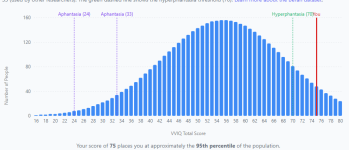
I scored 75 out of 80, which apparently puts me pretty far on the opposite end of the spectrum from Aphantasia, in Hyperphantasia territory.

population curve for VVIQ test
I find this topic fascinating though, because it's difficult for me to imagine what other experiences on the VVIQ spectrum would even feel like. I can understand it intellectually, but I can't make myself feel the feeling.
 
Last edited:
No. It's not that we don't recognize things we've seen before. We can see we're at the corner of XXX and YYY and know to take a left to get downtown.
I think it's beyond my capacity to understand.
I mean, I visualized a random man and woman riding in a car, and the husband chuckling about the bridge, from just this short exchange.
My mind automatically went there, it wasn't a conscious effort.
 
There's a well validated self-test called the Vividness of Visual Imagery Questionnaire, and you can take a version of it online!

I scored 75 out of 80, which apparently puts me pretty far on the opposite end of the spectrum from Aphantasia, in Hyperphantasia territory.

View attachment 2582854
I find this topic fascinating though, because it's difficult for me to imagine what other experiences on the VVIQ spectrum would even feel like. I can understand it intellectually, but I can't make myself feel the feeling.

I started to take the test but considering it's 100% subjective, how do you know how what you consider "reasonably clear" is what anyone else would call reasonably clear? I was expecting some sort of memory test, or a test like a color blindness test (that I fail spectacularly)
 
Last edited:
I started to take the test but considering it's 100% objective, how do you know how what you consider "reasonably clear" is what anyone else would call reasonably clear? I was expecting some sort of memory test, or a test like a color blindness test (that I fail spectacularly)
Apparently even though it's just a self-reporting questionnaire, it's well validated by research! Per wikipedia:

The procedure can be carried out with eyes closed and/or with eyes open. Total score on the VVIQ is a predictor of the person's performance in a variety of cognitive, motor, and creative tasks. For example, Marks (1973) reported that high vividness scores correlate with the accuracy of recall of coloured photographs.

...

Some critics have argued that introspective or ā€˜self-report’ questionnaires including the VVIQ are ā€œtoo subjectiveā€ and can fall under the influence of social desirability, demand characteristics, or other uncontrolled factors (Kaufmann, 1986). In spite of this issue, acceptably strong evidence of criterion validity for the VVIQ has been found in meta-analyses of more than 200 studies.
 
There's a well validated self-test called the Vividness of Visual Imagery Questionnaire, and you can take a version of it online!

I scored 75 out of 80, which apparently puts me pretty far on the opposite end of the spectrum from Aphantasia, in Hyperphantasia territory.

I find this topic fascinating though, because it's difficult for me to imagine what other experiences on the VVIQ spectrum would even feel like. I can understand it intellectually, but I can't make myself feel the feeling.
Two points higher, at 77. I bumped down a little on the shop imagery, but only because I couldn't decide quickly which shop. But once I got inside and saw Melissa, I was fine. The quick results didn't surprise me at all.
 
There's a well validated self-test called the Vividness of Visual Imagery Questionnaire, and you can take a version of it online!

I scored 75 out of 80, which apparently puts me pretty far on the opposite end of the spectrum from Aphantasia, in Hyperphantasia territory.

View attachment 2582854
I find this topic fascinating though, because it's difficult for me to imagine what other experiences on the VVIQ spectrum would even feel like. I can understand it intellectually, but I can't make myself feel the feeling.
Okay fine, I'll take this test instead of writing.
 
I scored a 60, but like @cw5523729 said I don't know how much to trust my score. I wish there were more specific questions rather than rating vividness. Like how many details etc. you can clearly picture. I didn't give myself any top scores because my mental images are not as crisp as "real" ones. But I don't have anything to compare them to.

Unfortunately, I score very low on surveys rating my ability to self-report in surveys.
 
There's a well validated self-test called the Vividness of Visual Imagery Questionnaire, and you can take a version of it online!

I scored 75 out of 80, which apparently puts me pretty far on the opposite end of the spectrum from Aphantasia, in Hyperphantasia territory.

View attachment 2582854
I find this topic fascinating though, because it's difficult for me to imagine what other experiences on the VVIQ spectrum would even feel like. I can understand it intellectually, but I can't make myself feel the feeling.
71 for me. The doors and items in display windows aren't my strongest attention grabbers.
 
I scored a 60, but like @cw5523729 said I don't know how much to trust my score. I wish there were more specific questions rather than rating vividness. Like how many details etc. you can clearly picture.

Exactly. It seems like someone could easily have designed the test such that you look at an image then have to remember the details so that your answers could objectively give you a comparison to "the average" unless I'm missing the point of it
 
Exactly. It seems like someone could easily have designed the test such that you look at an image then have to remember the details so that your answers could objectively give you a comparison to "the average" unless I'm missing the point of it
It's testing your imagination, based upon each suggestion.
Can you visualize each thing, and how clearly?

This is not professional advice, I'm not a doctor.
 
It's testing your imagination, based upon each suggestion.
Can you visualize each thing, and how clearly?

This is not professional advice, I'm not a doctor.

I started to take the test but then it was asking me about store fronts and boring stuff like that. If it had asked me to visualize a boob, I feel like I could have sailed through the test with flying colors.

Being serious, I got halfway through and found myself scoring everything "moderately clear" - but I also know I'm fairly bad with faces. I feel like I can visualize them "averagely", but when I hear about people giving a sketch artist all the details to make a drawing, I'm 100% sure I couldn't describe my own wife well enough to help someone draw her so I feel like my "moderately clear" isn't what an average person would call moderately clear.
 
I started to take the test but then it was asking me about store fronts and boring stuff like that. If it had asked me to visualize a boob, I feel like I could have sailed through the test with flying colors.

Being serious, I got halfway through and found myself scoring everything "moderately clear" - but I also know I'm fairly bad with faces. I feel like I can visualize them "averagely", but when I hear about people giving a sketch artist all the details to make a drawing, I'm 100% sure I couldn't describe my own wife well enough to help someone draw her so I feel like my "moderately clear" isn't what an average person would call moderately clear.
I'll be glad to send the test admins a strongly worded email on your behalf.
Just say the word...
 
Exactly. It seems like someone could easily have designed the test such that you look at an image then have to remember the details so that your answers could objectively give you a comparison to "the average" unless I'm missing the point of it
That instrument would be testing an entirely different thing, I think. Some people might be good at memorizing the idea of details, or memorizing facts. @AG31 could probably look at a map and memorize a route by thinking of it in terms of "travel X miles then turn left, travel Y more miles and turn right," and score just as well on your memory test, maybe better, then someone who could visualize the route as if they were looking at it from an airplane.

It all comes down to, we still don't truly know what experiences are, or how one person's experience is similar or different from another person's experience. There are whole branches of both philosophy and neuroscience dedicated to this stuff, and they still haven't found a way to prove any of it!

So self-reporting of how well you can visualize something in your mind really is the only way we know how to measure this. We don't have a brain scanner that can tell us what a person is thinking, or how they're thinking it 🤯
 
Last edited:
I've come up with this strategy to explain to people with visual imagery what it's like for us aphantasics.

Ask them what is in their mind when they think of the following things. Point out that you're looking for what's in their mind BEFORE they cast about for an appropriate image for xxxxxxxxx. Xxxxxxx is in their mind, with no picture, at that point.

ambiguity
conundrum
harmony
integrity
ambiguity
Possibility
Identity
Meaning
Continuity
Paradox
This is super interesting, because when I try to think of these concepts, literally the first thing that comes up for me is sensation of some kind, and then I have to process that sensation into words. Harmony is a sound first, and then I have to think about how to explain it. Conundrum is a mental image of a thief trying to disarm a trap. Paradox is a spaceship stuck in a time loop šŸ˜…

For the truly abstract concepts like meaning, it was actually really hard for me to come up with a simple explanation of my thought process, it just ended up being self-referential, "meaning is when you... well.. when something means..." 🤣
 
Totally unrelated - I read somewhere than whenever some starts a joke "A man walks into a bar", you always picture the exact same bar in your mind's eye.
I guess this is true in that I never visualise a bar...

I'd consider myself "partially aphantasic". I can visualise things via mental effort, and occasionally I visualise stuff in dreams, but mostly my imagination is a text-only medium. If an author writes something like "he was tall and had brown hair" I stow that away as two facts about the character, I don't visualise a tall brown-haired person. So when I'm watching the film adaptation I will never have a "that's not the shade of brown I imagined" reaction.

So, those of you who can't visualize things, what are your memories like?
Do you only recall words, not faces or people? How do you remember things you've seen?

Good at some things, terrible at others.

I struggle to recognise faces in an unfamiliar context. One time I met a workmate who I see every day, but it was outside work and he was wearing an unfamiliar hat, and that was enough to have me wondering "why is this stranger so familiar with me?"

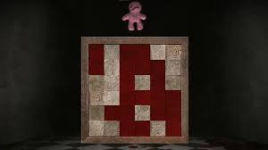
OTOH, recently I was playing an online game with friends. One of the mini-games involves showing everybody a grid like this:
1765491202399.png
We get a few seconds to look at it, then the image disappears and we have to reconstruct that. I got 100% on that one, and a week later I still remember the pattern exactly. Judging by the other players' reactions this is unusual.

This kind of thing works for me because it's very clear what I need to remember - it's not like looking at a photo where I have to guess what is and isn't important.

I don't think I'd read at all, if I couldn't imagine what anything or anyone looked like. That would just be passing my eyes over words.
This is where I live, but then I love words.
 
Back
Top