Planning when writing a story

i tried planning but it's like trying to herd cats when the characters get life. i'm not serious enough on Lit submissions to plan at all, so i go the discovery route -- which can have some unexpected and sometimes hilarious results when, again, the characters get life.

Speaking as a plotter, I never plan permanently. The story is always changing as I write, especially longer pieces. The story is a body. The plot/plan/outline is the bones. As I fill in scenes, the plot changes. I move around all the time from early to late to middle to late to early again, like constantly. Wherever I have the most urgent idea to shape something, whether that is to rearrange the bones of the skeleton, add a bone or two or to add add flesh to the bones, or to groom the skin and hair just so. Nothing is ever permanently placed until I'm doing my final read throughs and proofing and ready to hit submit.

I have come to find that turning this:

~go to store
~raining
~buy bread

into:

I went to the store. It was raining. I bought a loaf of bread.

is really no different than turning:

I went to the store. It was raining. I bought a loaf of bread.

into:

I had to go to the store for a loaf of bread. It was raining so I grabbed my umbrella on the way out the door. I asked the clerk for the carraway sourdough. He handed me the last loaf and I paid him the usual three bucks.

Then in the next chapter if I realize that it would be a better detail for the plot that there be raisin bread in the house, I would go back and change the carraway sourdough to raisin bread. It's no big deal.

So you see, plotting, fleshing and editing aren't much different for me. It's all just one big rolled up process. So if you look at it that way, even plotting is really just writing.
 
I start with an idea and begin writing short plot ideas into some sequence of chapter ideas. Often just what pink_silk_glove says. A phrase or sentence of what happens in that chapter. Then go back and add more phrases to fill the most interesting chapters. I will add ideas as I go through life and they come to me. Some of my best ideas get inserted here as the story churns in my mind.

Like a puzzle, I will move chapters and scenes as the story develops, and add connectors for flow. Then finally turn my notes into a story.
 
Hi,

I'm new to writing erotica, or just writing in general. I was wondering - do you plan the entire story out beforehand and fill in the minutiae as you go or do you write one chapter at a time and after each chapter is completed you think of the next chapter?

I have many ideas but I think trying to incorporate them all at once is turning it into a mess. Any help is appreciated, thanks.

Mostly, I write episodes (individual stories) rather than chapters (parts of a single story). I have written individual stories that I later use as part of a series, but at that stage, I am usually thinking about the overall direction it will take.

Broadly speaking, I start with an idea of the premise (setting, lead characters) and the starting point. From there come the endpoint of the individual episode and the series (the story arc), along with the steps in between. Usually, I run through the story in my head several times before I write anything down.

The actual writing process is iterative, with the draft looking like a patchwork as I add details. I use headings in Word to indicate the structure, which helps me stay on track, and a Table of Contents to quickly jump to the area I want to work on. Of course, all of that stuff comes out before publication.

At the start of a WIP document, I usually have a bullet list of key points/ideas that I work into the text, or save for later use.

If I were writing a longer piece with chapters, I would probably approach it similarly.
 
To add:

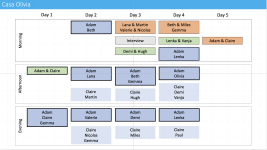
Like @pink_silk_glove and @Jorunn, I often move scenes around. As part of planning, I often use PowerPoint to help sequence things. For example, from a recent WIP, this shows who my lead characters are with during a holiday at a swingers' resort. Good for avoiding continuity errors, too.
Screenshot 2026-01-06 at 15.05.23.png
 
I generally know how my story will end and roughly how I want to get there when I start writing. And a rough estimate on how many chapters I will need to tell the story.

That's basically my approach. But I have a lot of respect for writers who come up with an idea and just dive in and see where it goes. I can't imagine putting time and heart and effort into a story and finding out it was a dead end.
 
The actual writing process is iterative, with the draft looking like a patchwork as I add details. I use headings in Word to indicate the structure, which helps me stay on track, and a Table of Contents to quickly jump to the area I want to work on. Of course, all of that stuff comes out before publication.

I think one of the biggest hurdle for new writers is getting past the idea that they have to write the story through from start to finish.
 
That's basically my approach. But I have a lot of respect for writers who come up with an idea and just dive in and see where it goes. I can't imagine putting time and heart and effort into a story and finding out it was a dead end.
The trick is to make sure it doesn't become a dead end.

I write until some kind of interesting ending starts to take shape. Then I go back and make whatever changes are necessary to bring it on course for that ending. Then forwards, and back again, and so on until it feels like a complete story.
 
To add:

Like @pink_silk_glove and @Jorunn, I often move scenes around. As part of planning, I often use PowerPoint to help sequence things. For example, from a recent WIP, this shows who my lead characters are with during a holiday at a swingers' resort. Good for avoiding continuity errors, too.
View attachment 2588312

In any story with a large cast of characters, I would also suggest using one of the many free family tree websites to keep track of the characters's relationships. Most allow notes on each name, so you can add details about them.
 
The trick is to make sure it doesn't become a dead end.

I write until some kind of interesting ending starts to take shape. Then I go back and make whatever changes are necessary to bring it on course for that ending. Then forwards, and back again, and so on until it feels like a complete story.

As I said, I have real respect for anyone who can write like that.Using my writing as a journey analogy, I'd be too anxious that I would find myself on a highway in Death Valley with just an eighth of a tank of gas and half a bottle of Diet Coke.
 
As I said, I have real respect for anyone who can write like that.Using my writing as a journey analogy, I'd be too anxious that I would find myself on a highway in Death Valley with just an eighth of a tank of gas and half a bottle of Diet Coke.
You might have heard the legends about my WIP folder...

But I just enjoy writing. I don't consider it wasting my time if the story remains unfinished. I might end up stranded somewhere, but I'll have enjoyed the journey, and perhaps one day I'll have the fuel to continue.
 
I don’t plan the shorter pieces I take an idea or an image or a memory and set it on the back burner of my mind for a while. Could be days, weeks, months, and keep adding things to it just like making a stew. Simmer. When it’s somewhat fully or what I feel is fully fleshed out mentally and is boiling I write, first in longhand so it’s fast and short and immediate. A very rough draft. Then I type it up and correct things in the editing while I add more or expand things and tweak language. I may do a little research on something I mentioned that I think needs more context and of which I know nothing about. Several edits until I feel it’s done. Sometimes the ending changes or isn’t the ending I intended, sometimes it just fades to black.

For longer pieces ( I’ve a novel and 2 novellas in various stages) I plan. A bit too much imo. I have character sketches, notes, research, charts, excel files, Venn diagrams, a tri-fold Bristol board with the classic 3-stage story arc and lots of sticky notes with plot points that I can move around when needed. It’s like a roadmap. I need this much planning because I tend to pick up and drop the novel over a long period of time ( going on 7 years now) and because it’s not always top of mind I need reminding when I pick it up of what the feck I’m doing and why.
 
As I said, I have real respect for anyone who can write like that.Using my writing as a journey analogy, I'd be too anxious that I would find myself on a highway in Death Valley with just an eighth of a tank of gas and half a bottle of Diet Coke.
As you know, I'm a pantser, through and through. I have several stories here, including an intricately self-referential meta story,** where I wasn't sure where they were going, so the characters go for a ride in a car and get to another place, and voila, the next story element works itself out.

It's the Jungian idea of a "journey", the psychological equivalent of going back through the same door to remember where you put your car keys. Variants for me include train rides (several stories) or commutes on the same bus route, seeing the same people. Works for me every time.

** Two story cycles arose from the same inspiration: a young woman I meet in the street one day and enjoyed a very EBish encounter, which in real life went nowhere, a real missed opportunity; but I liked her so much I wrote her into two different stories, as two completely different characters. Both stories have a central journey in a car, which propelled the plot forward.
 
To add:

Like @pink_silk_glove and @Jorunn, I often move scenes around. As part of planning, I often use PowerPoint to help sequence things. For example, from a recent WIP, this shows who my lead characters are with during a holiday at a swingers' resort. Good for avoiding continuity errors, too.
View attachment 2588312

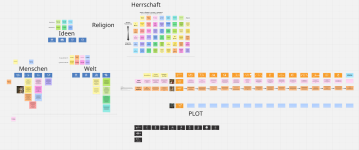
Almost as neat as my online whiteboard 🫣

1767717778514.png
 
Last edited:
I think one of the biggest hurdle for new writers is getting past the idea that they have to write the story through from start to finish.

Exactly. When I was like seven and writing something for school, I'd start with "Once upon a time ..." and write until I got to "... the end." Then once I was like eleven, I realized that I can jump around, cut and paste whole sections and such. It was a revelation. Writing chronologically suddenly became so limiting.
 
Basically, my ideas and inspiration don't come chronologically, so I don't write chronologically. I jot down the ideas while I can, before they are lost, and the plot skeleton is really just a way of keeping the ideas organized.

1 ~ It limits writer's block.
2 ~ It lets me maintain the big picture while I zoom in and fuss over details.
3 ~ It helps me keep all the loose ends connected and maintain cohesion no matter how crazy my ideas may get.
 
Basically, my ideas and inspiration don't come chronologically, so I don't write chronologically. I jot down the ideas while I can, before they are lost, and the plot skeleton is really just a way of keeping the ideas organized.

1 ~ It limits writer's block.
2 ~ It lets me maintain the big picture while I zoom in and fuss over details.
3 ~ It helps me keep all the loose ends connected and maintain cohesion no matter how crazy my ideas may get.
This idea is cool, but I just couldn't move my characters like that. It would feel like cramming them into a plot point, because they need to get from "the bagel scene" to "the car repair scene" even though only my characters will know if they are the kind of people to have a car repair scene. Do you feel as though your characters dictate much of your plot? Or are they characters who are set within a plot? No shade, at all, I just think that your process is really different from mine, and that makes it interesting.
 
Hi,

I'm new to writing erotica, or just writing in general. I was wondering - do you plan the entire story out beforehand and fill in the minutiae as you go or do you write one chapter at a time and after each chapter is completed you think of the next chapter?
For shorter stories, I'll plan the whole thing and then write it.

For longer stories, I will sketch out a rough story arc, with the things I want to do in the story and some idea of how it'll end, and then I fill in the plan in more detail as I go. Halfway through a 12-chapter story, it might look something like this:

Chapters 1-5: written and posted.

Chapter 6: written, with beta readers for feedback. Doesn't get posted until I've finished a draft of Chapter 7; that way I have some flexibility to change it if I realise I need to set something up for the next chapter.

Chapter 7: broken down into individual scenes with a synopsis for each scene, some scenes "complete" (until I decide to tweak them), others yet to be done.

Chapter 8: broken down into individual scenes, synopsis.

Chapters 9-11: summarised at the level of "they argue about whether to go to Legoland or Stonehenge, they break up, but then they reconcile", not yet broken down into scenes.

Chapter 12: planned in a bit more detail than 9 through 11 because letting the end sort itself out unplanned rarely works out.

Until it's published, nothing is set in stone. Sometimes I'll scrap part of the plan because I had a better idea. But I aim to go from one plan to another.
 
This idea is cool, but I just couldn't move my characters like that. It would feel like cramming them into a plot point, because they need to get from "the bagel scene" to "the car repair scene" even though only my characters will know if they are the kind of people to have a car repair scene. Do you feel as though your characters dictate much of your plot? Or are they characters who are set within a plot? No shade, at all, I just think that your process is really different from mine, and that makes it interesting.

My scene ideas are 90% derivative of character motive. My character is doing x and then y. At some point this character would totally do z and that would make a great scene, so I jot down z and place it somewhere in the skeleton where it best seems appropriate. Then later if more stuff means that z has to move up or down in the order, I will do so.

So it's kinda like that. Also remember that I never even start a story file until something has been fairly thoroughly brainstormed enough to inspire me as a strong idea.

Also bear in mind that I'm not so proud to do things just one way. I will take a good idea ANY way that I can get it, so this system allows me to just manage all of those ideas.
 
I usually come up with with characters first. Example. Dumb janitor guy with a big mushy heart and a sophistated manager lady with a broken heart. Then I start writing and explore different ideas.

If something feels out of character or doesn't drive the story forward in some kind of way, I go back to where it fell off and explore a different way.

If I come up with an idea that would require setting up, for example, maybe the lady teases/jokes that she could use a janitor/custodian at her place, so the guy teases/jokes that it sounds like what she really needs is a house maid, so the woman gives naughty smirk and teases that he would look nice in a maids outfit, which leads to an awkward moment where moment where she tryst apologizing for inappropriate joke, he assures its all good.

Which leads to him fantasizing about cleaning her place.

So I would save that idea and wrote towards it, but not rush. And if that idea doesn't fit or feel natural when I get their, I don't force it into the story.

That's the extent of my planning in most cases.
 
Back
Top