DOW Down 900 Points

Reminds me... I need to stock up on toilet paper. The last time we had that kind of dire prediction I was down to nearly searching for dried leaves to use. :poop:🍪🍿🍻
I was a Cub Scout and Boy Scout, so I learned to always be prepared. Sometimes that just meant being adaptable. As a young adult just learning how to live on my own, paying my own bills, buying my own groceries, cooking my own meals, I did run out of paper products a couple or a few times. Being adaptable, I figured out that Kleenex, paper towels, and coffee filters work as toilet paper in a pinch. And that paper towels, tissues, and toilet paper work as coffee filters. I also learned that SCENTED toilet paper makes lousy coffee. 🤢
 
I was a Cub Scout and Boy Scout, so I learned to always be prepared. Sometimes that just meant being adaptable. As a young adult just learning how to live on my own, paying my own bills, buying my own groceries, cooking my own meals, I did run out of paper products a couple or a few times. Being adaptable, I figured out that Kleenex, paper towels, and coffee filters work as toilet paper in a pinch. And that paper towels, tissues, and toilet paper work as coffee filters. I also learned that SCENTED toilet paper makes lousy coffee. 🤢
If it gets that dire, remember an old military substitute: socks make good coffee filters.🧦:coffee:(y)
 
Finance

Jamie Dimon says he still sees a recession on the horizon​

Published Wed, Aug 7 20243:10 PM EDTUpdated Wed, Aug 7 20244:32 PM EDT
Hugh Son@hugh_son

JPMorgan Chase CEO Jamie Dimon said Wednesday he still believes that the odds of a “soft landing” for the U.S. economy are around 35% to 40%, making recession the most likely scenario in his mind.

When CNBC’s Leslie Picker asked Dimon if he had changed his view from February that markets were too optimistic on recession risks, he said the odds were “about the same” as his earlier call.

“There’s a lot of uncertainty out there,” Dimon said. “I’ve always pointed to geopolitics, housing, the deficits, the spending, the quantitative tightening, the elections, all these things cause some consternation in markets.”

Dimon, leader of the biggest U.S. bank by assets and one of the most respected voices on Wall Street, has warned of an economic “hurricane” since 2022. But the economy has held up better than he expected, and Dimon said Wednesday that while credit-card borrower defaults are rising, America is not in a recession right now.

More here: https://www.cnbc.com/2024/08/07/jamie-dimon-still-sees-a-recession-ahead.html

From one of the most astute financial minds in America.
 
Dimon, leader of the biggest U.S. bank by assets and one of the most respected voices on Wall Street, has warned of an economic “hurricane” since 2022.

The economy is cyclical, so if you predict a downturn for two years you will eventually be correct. 😆

That’s like predicting it will rain. Eventually you will be right, although you may have to wait months in an arid climate.
 
Finance

Jamie Dimon says he still sees a recession on the horizon​

Published Wed, Aug 7 20243:10 PM EDTUpdated Wed, Aug 7 20244:32 PM EDT
Hugh Son@hugh_son

JPMorgan Chase CEO Jamie Dimon said Wednesday he still believes that the odds of a “soft landing” for the U.S. economy are around 35% to 40%, making recession the most likely scenario in his mind.

When CNBC’s Leslie Picker asked Dimon if he had changed his view from February that markets were too optimistic on recession risks, he said the odds were “about the same” as his earlier call.

“There’s a lot of uncertainty out there,” Dimon said. “I’ve always pointed to geopolitics, housing, the deficits, the spending, the quantitative tightening, the elections, all these things cause some consternation in markets.”

Dimon, leader of the biggest U.S. bank by assets and one of the most respected voices on Wall Street, has warned of an economic “hurricane” since 2022. But the economy has held up better than he expected, and Dimon said Wednesday that while credit-card borrower defaults are rising, America is not in a recession right now.

More here: https://www.cnbc.com/2024/08/07/jamie-dimon-still-sees-a-recession-ahead.html

From one of the most astute financial minds in America.
Wake us up when we've actually had two consecutive quarters of negative GDP growth.
 
Wake us up when we've actually had two consecutive quarters of negative GDP growth.
Recession or no recession this is what is going to kill us:

U.S. Passes $1 Trillion Quarterly Interest On The Public Debt​

Erik Sherman
Senior Contributor


May 30, 2024,12:39am EDT
Updated May 30, 2024, 11:22am EDT

There’s plenty of talk about the U.S.’ $34 trillion in public debt. Not the deficit — the amount of red ink every year spilled on the country’s accounts — but the cumulative total public debt. But a second number hasn’t received as much attention, although it should. That is the debt service, or the amount of money spent every quarter to satisfy the interest payments on the debt.

In the last quarter of 2023, the amount crossed a monumental threshold of $1 trillion every three months. It is only getting higher.

The national debt is important and a massive amount that, as the Peter G. Peterson Foundation notes, is not just high — the country has been in relatively high levels of debt before — but stratospheric in ways never before true.

More here: https://www.forbes.com/sites/eriksh...st-1-t-quarterly-interest-on-the-public-debt/
 
Bad news for you, @Rightguide. 😢

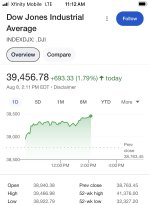
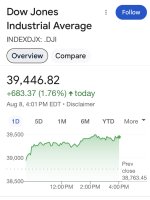
The Dow is way up with only a few hours to go. You’d better keep shilling or all your efforts to tank the US economy are likely to fail for the week.

🤡


IMG_5324.jpeg
 
Recession or no recession this is what is going to kill us:

U.S. Passes $1 Trillion Quarterly Interest On The Public Debt​

Erik Sherman
Senior Contributor


May 30, 2024,12:39am EDT
Updated May 30, 2024, 11:22am EDT

There’s plenty of talk about the U.S.’ $34 trillion in public debt. Not the deficit — the amount of red ink every year spilled on the country’s accounts — but the cumulative total public debt. But a second number hasn’t received as much attention, although it should. That is the debt service, or the amount of money spent every quarter to satisfy the interest payments on the debt.

In the last quarter of 2023, the amount crossed a monumental threshold of $1 trillion every three months. It is only getting higher.

The national debt is important and a massive amount that, as the Peter G. Peterson Foundation notes, is not just high — the country has been in relatively high levels of debt before — but stratospheric in ways never before true.

More here: https://www.forbes.com/sites/eriksh...st-1-t-quarterly-interest-on-the-public-debt/
The thing that kills me, is people supporting Trump on the basis of economy. If you (rightly) point to the public debt as the worst of it economic issues, then Trump ain’t your answer.

https://fred.stlouisfed.org/series/GFDGDPA188S

See that huge spike, that enormous glorious spike, the hugest spike in history? That was 2019 to 2020. The glory year for Trump economic policy. If it want to take credit or lay blame with a president (and I’m not sure many presidents have been directly responsible for many economic changes, good or bad) then Trumps performance was a dismal failure. Why would anyone want to double down on that?

But yet people are going to keep touting his great economic prowess. We need to find leaders who can work with Congress and industry and our stupid two party, tail wagging the dog system simply won’t allow that to happen.
 
The thing that kills me, is people supporting Trump on the basis of economy. If you (rightly) point to the public debt as the worst of it economic issues, then Trump ain’t your answer.

https://fred.stlouisfed.org/series/GFDGDPA188S

See that huge spike, that enormous glorious spike, the hugest spike in history? That was 2019 to 2020. The glory year for Trump economic policy. If it want to take credit or lay blame with a president (and I’m not sure many presidents have been directly responsible for many economic changes, good or bad) then Trumps performance was a dismal failure. Why would anyone want to double down on that?

But yet people are going to keep touting his great economic prowess. We need to find leaders who can work with Congress and industry and our stupid two party, tail wagging the dog system simply won’t allow that to happen.
His economic policy position is to impose tariffs across the board.
 
Recession or no recession this is what is going to kill us:

U.S. Passes $1 Trillion Quarterly Interest On The Public Debt​

Erik Sherman
Senior Contributor


May 30, 2024,12:39am EDT
Updated May 30, 2024, 11:22am EDT

There’s plenty of talk about the U.S.’ $34 trillion in public debt. Not the deficit — the amount of red ink every year spilled on the country’s accounts — but the cumulative total public debt. But a second number hasn’t received as much attention, although it should. That is the debt service, or the amount of money spent every quarter to satisfy the interest payments on the debt.

In the last quarter of 2023, the amount crossed a monumental threshold of $1 trillion every three months. It is only getting higher.

The national debt is important and a massive amount that, as the Peter G. Peterson Foundation notes, is not just high — the country has been in relatively high levels of debt before — but stratospheric in ways never before true.

More here: https://www.forbes.com/sites/eriksh...st-1-t-quarterly-interest-on-the-public-debt/

Trump set the record for the most added to the national debt in one term. 🏆 Bush and Reagan similarly ran huge deficits and increased the national debt.

Republicans only pretend to care about the national debt when a Democrat is in the White House.
 
The Dow Jones has just had its best day for two years!

Debt is the US problem, directly caused by Trumps decision to give tax concessions to the wealthy. Obviously RG will be along shortly to advocate an increase in Taxes to reduce debt.

All Presidents since Reagan with the exception of Clinton have increased Federal debt. Trump increased it by far the most.

All GOP Presidents since Reagan, bar none have increased public spending by more than the rate of inflation
 
THIS IS A SLIGHT REVISION TO POST 110, NOW THAT MORE INFORMATION IS KNOWN

Okay, the US Stock Market has closed for the week. After all the sturm und drang, the market as a whole is basically where it was at the start of the week, and the Liberals here can point and laugh once again at the hapless MAGAts.

Everything's cool, right?

Not....exactly.


There is something called the "VIX Index", which measures market volatility. 98 times out of 100, it swings plus or minus a few points, right around 15 on the scale of 1-to-100. Market trades are priced to accommodate the risk of 5 points swinging either way

This week it lurched by an ungodly swing of 60 (SIXTY) points.


That's bad. REAL bad. Bad as in "third worst week volatility-wise this century".
The other two weeks worse than this week?
  1. The week Lehmann Brothers failed in September 2008 and ushered in the Sub-prime crisis and Dubya recession.
  2. The week in March 2020 where Donald Trump's bungled handling of the Covid crisis was so bad that a nationwide lockdown occurred
So what the absolute fuck happened?
It appears THIS happened:
  • The 14 biggest hedge funds borrow all available Japanese Yen one-year bonds every single trading day of the year.
  • They factor the price they pay to allow for a variance of 1 percent either way.
  • They immediately convert Yen-to-Dollars and purchase one year US Treasury Bonds
  • The US Treasury Bond pays interest around 5 percent, cost of funds is zero. Clear profit automatically! Life is good!
  • The 14 biggest hedge funds buy stocks on the NYSE and NASDAQ using these bonds as surety.
  • Exactly one year later, these hedge funds cash out the US Treasury Bonds, and use the US$ to pay back the.

Japan fucked up this assembly line arbitrage when it boosted the cost of funds not one-half-percent, not one percent, but an unprecedented FIVE percent last week. Now the hedge fund "automatic profit" of 5% in one year has vanished in the course of one DAY.

The hedge fund gravy train, which had run like clockwork for TWO YEARS, suddenly derailed.

The kimono opened, and hedge fund traders were exposed as being massively overleveraged, probably in violation of US securities laws (not unlike credit swaps in 2008) so the result was hedge funds needing to pay a big premium to pay back Japanese yen loans.

The hedge fund traders had literally NO RESERVE for this contingency, so they had to sell stock to cover their loans....
AT ANY PRICE.

Well, it turns out that the hedge funds had almost exactly the same companies in their portfolios, straining to get that extra penny of value.

So the market as a whole dropped 900 points while hedge fund traders had fire sale prices on lesser-profitable "non-tech" stocks. Their tech stock portfolio were their "cash cows", they'd be the last to go.

Everyone at first thought the market was reacting to Goldman Sachs "when are we going to see tech companies have Artificial Intelligence profits?" public shitpost....but every stock EXCEPT tech stocks melted down.

Nobody knew how low the market would go. Uncharted territory...just like 2008!

If you were a smart "market trader" (like AJ, who NEVAR loses in the market, just ask him!) and bought stock this week, you made some money.

Once the hedge funds unwound their suddenly unprofitable Japanese Yen positions, they began buying the hell back out of the stock market to recapture their same positions, but nobody knows (yet) how they are profitably funding their trades now.

Bottom line: Hedge funds made the "Goldman Sachs hissy fit dip" exponentially worse by somehow figuring out how to massively overleverage stocks (something theoretically impossible since financial reform in 2012) and nobody can figure out how they are funding their shenanigans
 
Stock market today: S&P 500, Nasdaq rally to fully recoup losses from August sell-off

Stocks ripped higher Thursday as Wall Street took in signals that pointed to a still-strong US consumer and labor market. The Nasdaq Composite (^IXIC) popped more than 2.3%, while the benchmark S&P 500 (^GSPC) rose more than 1.6% and the Dow Jones Industrial Average (^DJI) rose about 1.4%, or roughly 550 points.

The daily fluctuations of the stock market mean nothing, but it’s amusing in comparison to what the Chicken Littles were yelling a couple weeks ago.
 
Stock market today: S&P 500, Nasdaq rally to fully recoup losses from August sell-off


The daily fluctuations of the stock market mean nothing, but it’s amusing in comparison to what the Chicken Littles were yelling a couple weeks ago.
The only thing that concerns me is Warren Buffett selling off half of his Apple stock portfolio. He's no longer the biggest single investor. Market analysts believe that Buffett has no confidence in Apple's upcoming homegrown AI product after the embarrassing Beta rollout recently.

(an AI-enabled Siri was installed on a reporter's phone. The reporter asked the AI "Show me all of the pictures of my wife on this phone. The AI went to his contacts, correctly deduced that his wife was named Brooke, then queried the Internet and presented the reporter with an album of the 100 most downloaded pictures of actress Brooke Shields.) Ta- DAAAAH!
 
Back
Top