$20 Words

"Bangs" is a very dated description of a hair style, I think. You'd far more likely say "fringe", these days.
I still hear "bangs" on a regular basis in the US. I mean, as regular a basis as I hear any descriptions of hair styles. Maybe it's a regional thing.
 
I still hear "bangs" on a regular basis in the US. I mean, as regular a basis as I hear any descriptions of hair styles. Maybe it's a regional thing.
Could be. I don't ever recall hearing it said here in Oz, which has some state-based language oddities, but not many.

I'd picture the young Shirley Temple if anyone used "bangs" as a description of a hair style. So that's early Nineteen-thirties, culturally.
 
I've heard bangs more often that fringe, and the majority of the times I've heard fringe was to describe the hairstyle normally associated with emo culture.
 
Just yesterday, @Voboy sent me googling when he used the word "palimpsest." Very cool word, if somewhat pretentious. ;)
Love that word. It appears in Chapter 1 of the Handmaid's Tale.
Chiaroscuro
OneHitWanda used it in the title of one of her stories.

Sometimes characters need to use the big words, as that's who they are. There's less of an excuse for narrators to do so, however.

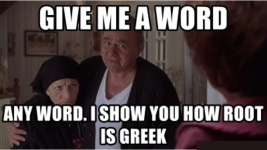
What is interesting, though, is that often the more uncommon words have Latin or Greek routes, and are thus more likely to have cognates in other languages. So, by using them, you may actually make your work more accessible to non-native speakers of English.
 
Guilty. A comment from @avp92117
I've never had to look up so many words before while reading a Literotica story.
 
I used to pride myself on using an extensive vocabulary until a colleague complained that she had to use a dictionary whenever she received an email from me.

That, plus thirty years working with non-native speakers, has cured me of that in business communication. But, on Lit mwhahahah! :devil:
 
"Fringe" sounds like something which would be on the sides. Not in the front.
 
"Fringe" sounds like something which would be on the sides. Not in the front.
"Fringe" is way more common than "bangs" in the (Southern) UK.

But, US pals, what about "Oklahoma" and "the surrey with the fringe on top", hmmm?
 
Strange. I was pretty sure that “bangs” refer to the patches of hair encroaching down the sides of your face, along the ear, and threatening to merge with your beard if you got one. Nothing to do with the mane overhanging your forehead.
 
"Fringe" sounds like something which would be on the sides. Not in the front.
In Oz, the fringe is definitely the front of the hair style, down over the forehead, and the length sometimes depends on the parting.
 
Strange. I was pretty sure that “bangs” refer to the patches of hair encroaching down the sides of your face, along the ear, and threatening to merge with your beard if you got one. Nothing to do with the mane overhanging your forehead.
Those would be sideburns, in Oz. Very seventies, rarely seen nowadays.

I'd only ever associate bangs with little girls, like the young Shirley Temple. For me, it's a very dated term, pre WW2.
 
What is interesting, though, is that often the more uncommon words have Latin or Greek routes, and are thus more likely to have cognates in other languages. So, by using them, you may actually make your work more accessible to non-native speakers of English.
Interesting idea. Giving it some thought, I believe that as much as it may help, it could also be a double-edged sword.

I believe It very much depends on what's the native language of your reader. Those who speak languages that borrow copiously from Latin, like Italian or French, would likely be able to decipher many English words that share the same roots. But once you move to Germanic languages, they don't borrow nearly as much, probably as a combination of bigger Norse influence and the higher ability to coin new words on the fly. Move even further out of the Mediterranean, into Finno-Ugric and Slavic areas, and the influence of Latin (or Greek) wanes even more.

The other issue is that the simple fact English and the other language borrowed the same root from Latin or Greek doesn't dictate that the resulting words necessarily mean the same thing. "luna" is a funny example; in English, it produces words associated with madness, like lunacy or lunatic. Well, can you guess what "lunatikas" in Lithuanian means, or "lunātiķis" in Latvian, or "лунатик" (lunatik) in Russian?

That's right -- a sleepwalker. Some friends are very false indeed.
 
What is interesting, though, is that often the more uncommon words have Latin or Greek routes, and are thus more likely to have cognates in other languages. So, by using them, you may actually make your work more accessible to non-native speakers of English.
In my travels around Europe, I have often made sense of words from knowing English + bits of Latin, French, and Dutch.
 
Back
Top