Techniques to avoid having to mention place names?

I don't see the purpose of setting something in a well-known city, and avoiding giving at least a hint to the city it is in.
If they are well known, then they do not meet the OP's wish to avoid "locking in geographically."
 
I don't see the purpose of setting something in a well-known city, and avoiding giving at least a hint to the city it is in.
Nor do I. The reluctance to name a place, real or fictitious, feels like painting oneself into an unnecessary corner.
 
I set 90% of my stories in the same town, a place called Seaborne: it's coastal, medium-sized, and contains all the settings I ever need to use. Inland there's a state forest; beyond that are a few other towns, for when I need to branch out. I never name the state, but I think it's somewhere on the Chesapeake Bay or nearby. It's far enough north that they get some snow when I need it to snow.

Nobody has ever complained that it's unrealistic. So, OP, I'd suggest just inventing your own location. No need to get specific. If you write enough stories there, the town will grow on its own, organically, just like a real town does. You'll invent people to live in your town, and after awhile it'll feel like a very real place.
I have an eerily similar approach, right down to the adjacent State Park. My fictional town is called Shore Points and a lot of the businesses and landmarks located there appear across multiple stories. It’s fun building that element into my extended universe.
 
I still don't really understand the OP's reason for wanting the location to be anonymous.

If it doesn't matter, it doesn't matter.


Why does this matter?

Even though it might not matter to the author, real places may still matter to the reader, in ways that can conflict with the author's objectives.

At the simplest level it can create continuity problems: "it's impossible for these characters to be standing on this bridge, because the story is set in 2016 but the bridge wasn't built until 2019" kind of thing.

Locations can also come with their own baggage. If one wants to write a big-city story set around 2000, and they make that city NYC, reader knowledge of 9/11 is going to overshadow that story. Sometimes an author can work with that, but sometimes it's preferable to avoid that kind of baggage and go for Generic Bigtown.
 
My publisher has a story set in his hometown; if you've ever been there, you'd know where it was. So all his old classmates will know it's the town they grew up in. He never names the town, but he does name towns near it, and makes it obvious it's in the middle of the Oklahoma Panhandle. He names the five-mile bridge, north of town, and the seven-mile bridge, northeast of town, names the river, and states that it flowed all year round in the late 60s, when the story is set. He made a few changes to businesses, fake names, and the story is total fiction. But still, you get the feel of the town in the story.
 
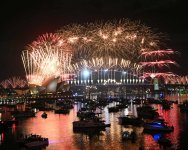
Well, they are hard to miss when you are in Sydney. If you want to evoke the place for an international audience, what else is there?

EDIT: throw in Uluru, some kangaroos, a koala, and Crocodile Dundee, and you have exhausted most people's image of the country.

*cough*
Vegemite.
*cough*

I have an eerily similar approach, right down to the adjacent State Park. My fictional town is called Shore Points and a lot of the businesses and landmarks located there appear across multiple stories. It’s fun building that element into my extended universe.

These days, I occasionally wish I'd picked a different name than "Seaborne." It's fine, but every time I type it I think of that character from West Wing.
 
I think that, if it's going to be a plot point that characters come from the same place, not naming the place is just gonna hang a lampshade on it.
Nevertheless it will accomplish the goal, so
 
I have a couple of things to add to this thread.

I have a story dropping tonight that the town where it takes place is a main character - it figures prominently throughout the entire story. I name the region where the town is located, but it's a fictional town because I doubt I could have found a real town (using Google Maps and Wikipedia) that would have matched the qualities I created.

For five years, I lived in a very small town - less than 800 people. So I was surprised when that town was used as a location for a story I read. As I read it, it was clear that the author had never lived there and probably never even passed through it. But I contacted them by email and I think they enjoyed the information I could provide to them about the little town. It certainly didn't bother me that the author lifted the name of the town for their story, but it's not something I will normally do.
 
I've often used real places that I've been to or researched. I've written incest stories where the action takes place in Rhode Island, New Jersey, or Ohio, the three US states where adult consensual incest is legal. (Except parent-child in Ohio.) But in other stories, I use real places for color. My current WIP, which is a romance has takes place in three different unnamed states that are a plane-ride apart.
 
*cough*
Vegemite.
*cough*
I doubt that many people outside Australia have ever heard of Vegemite, let alone know what it is or where it comes from. You might as well mention Tim-Tams.

These days, I occasionally wish I'd picked a different name than "Seaborne." It's fine, but every time I type it I think of that character from West Wing.
I'm afraid that was my first thought.
 
Does anyone have any techniques for avoiding listing where something is taking place, in a scenario where place OVERLAP, but not the place itself, is important to the plot?

For example, say one character needs to have been born in the same city as another for reasons important to story later on. The city itself doesn't matter, just that they're from the same one. Let's say the dialogue calls for something like:

How do I avoid having to fill in something specific for [place] (either by making up some fake city name, or worse, choosing a real one and thus locking the story in geographically).

Glossing over or summarizing the dialogue is also not really an option, as the cases where I've got this problem all occur during the course of an important conversation, and the equivalent of bringing up the sister-in-law is actually the impetus for the next major plot point.

Anyone else struggle with this and have any clever ideas or techniques?

I don't see a problem naming states or cities. But, I do use a lot of parody names in my stories. Some people love it, some people think it breaks immersion. Some ways to handle it would be if the place is known to both people. Example: I told her where I was from and she immediately lit up. "Oh! You're from that shithole, too? How'd you manage to escape?" Then talk about some of the features.
 
It's not a technique.
There's no literary knowledge or skill required to simply make up a name or refer to a place by type (old factory, home town, huge ranch, etc).
 
Since most of my stories are set in a mythical version of India, I mostly just use The City (where slutty secretaries and bored rich housewives residency) and the The Village (where thirsting village belles and widowed bhabhis yearn).

Sometimes I'll use real city names, but as a writer, I love the comfort of knowing that my settings are as unreal as my stories and fantasies.
 
I doubt that many people outside Australia have ever heard of Vegemite, let alone know what it is or where it comes from. You might as well mention Tim-Tams.

Two people have already mentioned it, but... "Land Down Under" by Men At Work. Any American of the right generation will have heard of Vegemite in conjunction with Australia, though to be fair they might not really know what it is. They certainly won't have tried it.

I did, out of curiosity. I don't recommend it.
 
Hey we 'Muricans know a wee bit more about it.

Walkabout
Billabong
Boomerang
Outback

We may know know what they are or what they do, but we've heard the words.

We also know that the Aboriginals were historically and continue to be mistreated.
 
Two people have already mentioned it, but... "Land Down Under" by Men At Work. Any American of the right generation will have heard of Vegemite in conjunction with Australia, though to be fair they might not really know what it is. They certainly won't have tried it.
That song is where I first heard of the stuff … 45 years ago! Because of the 'mite' ending and my familiarity with Marmite sandwiches in the UK, I was able to make an accurate guess about what it was.

I did, out of curiosity. I don't recommend it.
I have both Vegemite and Marmite in the cupboard, but I reach for the former more often.
 
Hey we 'Muricans know a wee bit more about it.

Walkabout
Billabong
Boomerang
Outback

We may know know what they are or what they do, but we've heard the words.

We also know that the Aboriginals were historically and continue to be mistreated.
OK.

None of which says 'Sydney'.
 
That song is where I first heard of the stuff … 45 years ago! Because of the 'mite' ending and my familiarity with Marmite sandwiches in the UK, I was able to make an accurate guess about what it was.


I have both Vegemite and Marmite in the cupboard, but I reach for the former more often.

When my culinary experiments with Vegemite didn't work out, I tried Marmite next.

No thank you. Lol. I'll stick with good ol' American PB&J, or maybe CC&J.
 
That's the place with the weird roofed opera thing, isn't it?
Sydney 2026.jpg

New Year 2026 celebrations featuring the two things that scream Sydney. When I used to visit the city regularly I often stayed in one of the buidlings visible beyond the bridge.
 
Back
Top