Tracking Word Counts

HyunnaPark

TheRedLantern
Joined
May 10, 2025
Posts
749
Really, I'm just curious as to what people's thoughts are on tracking word counts.

I started tracking word counts during my first NaNoWriMo (RIP) and it intuitively made sense to me. It was satisfying to see that number climb and to think "I did that" when I hit that 50K goal. It was a very useful tool when I was first developing my writing practice and discipline. It was also great when I was stuck and just needed to get moving so that the writing could begin generating its own ideas.

BUT ... I never liked anything I produced this way and I recently realized why when trying it again. It's because, for me, cutting things that don't work or that don't fit my vision is a big part of my process. So tracking word counts can cause me to fight my instinct and leave known problems in the work (if you've spent a lot of time building software, you have an evidence-based opinion on this topic ... whether that wisdom is transferable is not yet clear to me but the feeling I get when I know there's a problem in my work is still visceral enough to distract me until it's fixed).

I've noticed myself having success with a bit of a hybrid approach, tracking word counts during the initial "lift off" of the project when I'm liable to get analysis paralysis, and then abandoning them once I've found The Story and I want the psychological flexibility to backtrack and clean up some word count hairballs that I coughed up.

I'm not claiming this is a good method, just that I've inverted my thinking a bit about writing process tools & techniques. I used to look for techniques & advice that would help me write, but what's been more useful has been ones that have let me help my brain avoid known pitfalls that are likely to sink a project of mine.
 
I track word counts/pages in terms of my daily/weekly production. That works better for me than setting aside chunks of time to write, just because sometimes when I'm "writing" I'm not really writing. I'm, for example, sitting with a cursor blinking in a word document while I type up a summation of my approach to word count for an internet forum. If I'm shooting for a word count and I get distracted, I just have to get my shit together and keep at it.

I might keep something in a draft I know isn't working for the duration of a week, just to track my production for that week toward my page goal. It counts as writing even if it's not very good. But I'll chop it right out come Monday.

I don't have a word count goal for works as a whole. Their length is 100% determined by the needs of the story. I tend to get some idea once I've started how long something is going to be, but that's changeable. Sometimes I get to a point far sooner than I intended, where I say Huh, this is ready to wrap up. And sometimes I'm far beyond the length I was going for and find I'm only just getting started. Either way is fine with me, and I have no hesitation to change my plans if the story says so.
 
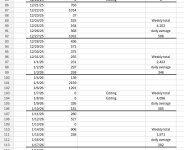
My goal is to write something every day. One way I keep myself accountable to it is a word count tracker. Every day when I start writing, the first thing I write is the date. Then when I’m done with my writing for the day, I count the words I’ve written that day and put that word count into a basic spreadsheet. I don’t obsess over it. I just enjoy seeing how my words accumulate over time, and it helps me keep to my goal. Here are my most recent weeks in my spreadsheet:

IMG_0007.jpeg

I’ve done nanowrimo twice. In both, I managed over 60,000 words. Fun, but really burned me out. Personally, with everything else going on in my life, 500 words a day is sustainable and satisfies my urge to write.
 
I keep track of word counts quite obsessively. However I don't do it to meet any target of length. I do not care how long the story will be.

Reasons for tracking word counts:

1 ~ Progress. I feel much better having an idea of just how much I have accomplished. How far have I brought the story and how much farther there may be to go. It just helps to keep me on track and not lose myself in a fog of words and ideas.

2 ~ Productivity. It lets me know how much I have done in a day. I write for a few hours and at the end of the session, count up the words. If it's 700 more than it was before I sat down then I know just how productive my hours were. I know that I spent the day dabbling around with small edits and a few notes and didn't get too far so I should roll up my sleeves and get more done in the next setting, or whatever.

3 ~ Pacing. I keep track of word counts often by scene. This way I know just what I'm putting the reader through. I just had two short scenes, so it's okay to have a longer one next. I just had two longer scenes back to back so I need to change gears. Each scene can be a jumping off point if someone needs to read the story in multiple sittings, so I am aware of where those points are.

4 ~ Analysis. I have a full understanding of just how long a sex scene will usually be, or some other heavy plot change scene might be.
 
Every day when I start writing, the first thing I write is the date. Then when I’m done with my writing for the day, I count the words I’ve written that day and put that word count into a basic spreadsheet. I don’t obsess over it. I just enjoy seeing how my words accumulate over time, and it helps me keep to my goal. Here are my most recent weeks in my spreadsheet:
That looks almost exactly like mine except I also had a column for "time of day" since I found myself doing more than one writing session per day a lot of times and I was curious if I had a time that was "hot" for me. I don't. I like how you have a column where you can note that you were editing.

It seems like the main theme from how you're recording this is the date and a short note about what you did that day ("Editing" or a count of words) in order to motivate yourself to engage with your writing every day. I might steal that idea (that will be the title of my autobiography)
 
For me, keeping track of words per writing session makes writing more work than fun, so I don't. I tend to write in "scenes", and a scene takes as many words as it takes. I don't actually count words per paragraph, but I do count lines on my monitor. That's so a paragraph will typically show on even a laptop screen in its entirety.

I do track word counts per story, but only because I occasionally look at the data to see if there's any correlation between word counts and genre, votes, or comments. So far, I haven't found any correlation.
 
It seems like the main theme from how you're recording this is the date and a short note about what you did that day ("Editing" or a count of words) in order to motivate yourself to engage with your writing every day. I might steal that idea (that will be the title of my autobiography)
I used to write a short summary of what I accomplished — like “finished writing 1st kiss scene”, but that was more work than it was worth. Plus I use scrivener to write now, so it’s easier to break up the stories into scenes anyways.
 
I tend to only look back to see how productive I was over an extended period of time. I know very well on a day to day basis whether I feel productive or not.

It helps for me that despite being a mediocre writer, I'm at least fairly prolific. Except when I'm in a funk and nothing comes out. But that's a qualitative reality, no numbers needed.
 
Plus I use scrivener to write now, so it’s easier to break up the stories into scenes anyways.
I've been thinking about it. I use Google Docs because it's easy to back up & share but I think of a story as a collection of scenes and Scrivener supports that really well.
 

Tracking Word Counts​

When I’m writing, I periodically paste the latest draft into the Lit textbox to a) see if I got the formatting right, b) to get a formatted source to share the latest section with whomever is alpha reading it (mostly @Djmac1031 but also others), c) use iOS speak n spell to listen to the text. I normally check the word count at this point, but don’t typically record it.

The only time I recorded word count over time was with my novel (did you ever finish it, BTW?) I did this as a motivational factor, and also as I wanted the first five parts to all be comparable lengths, each one around the 15k word mark, plus or minus 2k.

And I also had a guesstimated overall length, which I used to create a rather inaccurate percentage complete figure, again for motivational reasons.

I also calculated how many words I wrote per day and used this to estimate how many days I had left.

I wrote and published many other stories in parallel, but I only did the above with Nix. It helped.
 
Word count is a good way to keep track of time/effort/whatever spent producing words that could be useful for the end product of a given story, as opposed to staring at a blinking cursor with writing block, or revising and re-revising vague ideas for what the characters are going to do three chapters in the future with no idea how to connect the current part of the story to that, or writing something for another story entirely, or commenting here.

The word count of a finished story is a good way to measure the commitment and investment it requires of a reader. A vignette or flash fiction is probably up to 2,000 words; a "normal" short story is probably 3,000-30,000 words; a novella is 50,000-80,000 words; an epic fantasy novel is at least 200,000 words. I know there are gaps in there and people can dispute where to draw the lines for them, but I think the basic point holds.

The word count of a story has very little to do with how good it is. There are some very good short stories and very bad epic fantasy novels.

Personally, in my final draft of a story, the word count will usually be fairly close to the first completed draft, because while I'm mainly focused on deleting unnecessary adverbs and stuff like that, I'll often add in details that were obvious to me on the first pass but I later realized should be made explicit. But sometimes there are big differences in either direction; sometimes I realize entire scenes can be cut, or entire scenes needed to be added. I track word counts for NaNoWriMo, but for writing here, only when I feel behind. Whatever length the finished story is, it is.

It helps that I'm writing mostly episodic stuff. I have a work in progress that will be significantly longer than anything else I've written here and when it's finally done, I'll have to think about whether to break it up for publication or not, but for most stories in series, I can hit "publish" with clear conscience as long as a conflict as simple as "did the date go well?" is set up and resolved.

And with that, back to my next WIP. I'm going to get 1200 more words of it today or else, damn it.
 
I don't keep track of how many words I write per day. As long as it's a few hundred, which is intentionally a very wide bracket, I'm satisfied with my output.

It may have something to do with the fact that if I find some passages not to fit the initial idea of the story, I'm more likely to just write more to fit them in rather than toss them outright.

Sunk words fallacy, you may call it.
 
Really, I'm just curious as to what people's thoughts are on tracking word counts.
Not per day.

As I write, I keep an eye on the story length, though I don't really do anything with it.

I do have record word & page counts on my master list of stories.
 
did you ever finish it, BTW?
😓 Not yet, I got sidetracked trying to figure out what Romantasy is. Thanks for the reminder, I think I'm on part 5.

And I'm glad to hear your thoughts on this. I was looking at your work on your Nix story, how you did it, and how you rolled it out as a model for how I wanted to approach my first big writing project. I remembered you saying you had split your story up into chapters to manage the size of each document, so I figured you had also used those "chunk sizes" to help organize scenes into roughly equal sized chapters and it's helpful for me to see that this is what you did.
 
😓 Not yet, I got sidetracked trying to figure out what Romantasy is. Thanks for the reminder, I think I'm on part 5.

And I'm glad to hear your thoughts on this. I was looking at your work on your Nix story, how you did it, and how you rolled it out as a model for how I wanted to approach my first big writing project. I remembered you saying you had split your story up into chapters to manage the size of each document, so I figured you had also used those "chunk sizes" to help organize scenes into roughly equal sized chapters and it's helpful for me to see that this is what you did.
Yeah - feel free to PM me if you have any questions, or just to chat 😊
 
It may have something to do with the fact that if I find some passages not to fit the initial idea of the story, I'm more likely to just write more to fit them in rather than toss them outright.

Sunk words fallacy, you may call it.
This is the exact situation that prompted this thread. I was stressing myself out yesterday over something I wrote that didn't work the way I wanted, but because I was keeping track of my word count I didn't want to delete a page or two of text and be "in the hole" for the day, so I burned myself out trying to think of a way to make it work. And everything I did made it worse because I was trying to build on a weak foundation.

In hindsight, if I hadn't cared about the word count, I would have just deleted the mediocre passage, stared out the window to see if the Indian couple across the street were getting it on (they were not), and come up with a better way to frame and set the scene that I needed. It's what I wound up doing anyway, but I had to let go of the attachment to word count and do what you & Jackie are doing, which is aim for "daily forward progress" which may or may not include a word count. Jackie's managed to capture the best of both worlds, the accountability and motivation of the daily record along with the flexibility she needs to manage the creative process, while keeping the whole thing simple enough that the process does not add overhead.
 
This is the exact situation that prompted this thread. I was stressing myself out yesterday over something I wrote that didn't work the way I wanted, but because I was keeping track of my word count I didn't want to delete a page or two of text and be "in the hole" for the day, so I burned myself out trying to think of a way to make it work. And everything I did made it worse because I was trying to build on a weak foundation.
On the rare occasions that I do excise longer parts of the story (i.e., more than a few paragraphs), I usually just move them somewhere else -- either to a separate file, or at the end of the current document.

(My drafts always contain an ephemeral outline that's a few empty lines below the current end; I use square brackets for it so my editor highlights it in blue. If I have to move something out, I just cut and paste it below that outline).

This may not seem like a significant difference, but it feels psychologically better than just deleting the passage outright. If It's close at hand, I can also draw from it if I need to, taking singular sentences or phrases.

And then, at the end, if it turns out I don't need it after all, it doesn't feel bad at all to remove it, days and weeks later, when the story is already finished.

You may try doing something similar and see if it works for you.
 
Interesting issue. I think all of us oscillate between creator and editor, depending on different stages in the process. And something like word count can function as a spur early on. Here's an account of the other end of the spectrum, the editor ruling the roost:

As an undergraduate my favorite instructor was ABD (all but dissertation) at a different, elite institution (finished all his coursework, all he needed for his PhD was to complete his diss. Ha.)

So after a long day of teaching and coping with us (hopelessly talent-scarce but uber-confident) undergraduates, he would go back to work on his diss. He confessed that on a good night he'd get a good couple of typewritten pages done (he would have killed himself before using a word processor, or gasp, a computer to write.) 500-1000 words a night my guess, on a complex and difficult topic. Excellent.

In the cold light of morning, he would edit the previous night's progress all down to one or two sentences, each a jewel of perfection, and was happy with the result. Distillation carried to extremis. So every semester (sixteen weeks perhaps) he would get maybe one or two thousand sentences further towards his final goal.

Moral of the story: it took him twenty-five years to finish his magnum opus (if not a record, a still unbelievable amount of time.) And got his degree.

Don't give your editor too much power or nothing will happen.
 
I like to read stories on this site at between 25-30k words. With some exceptions, that’s where my favorites landed. So that’s the sweet spot I target when I write, and it isn’t easy. I track it hard. I hate that feeling when I know I’m going to go over. Tracking word count can help set my pacing in advancing a story, setting milestones, my plot lines tend to need that. I sometimes scold myself or write a warning at the bottom of the page, “DON’T GET WORDY!”
 
I am constantly obsessing over word counts, largely because I tend to view it as a yardstick for how much farther I need to go to be near completion. It also helps me figure out when to cut things short or when to elaborate, so that each of my stories/chapters has about the same feel and I feel like my readers are getting enough bang for their buck, especially since I'm not publishing at the frenetic pace I was when I started.

I just did the math, and I'm up to 822,781 words in my three books (the third one is still incomplete - five more chapters), so I'm on pace to crack 1 million here this year, if you combine all my standalones and the three stories.

I find myself looking at things similarly to what PSG does - tracking helps me maintain pacing and confirm I'm making progress, and I try to keep my chapters on the slightly larger end so that it takes folks time to read them and they aren't tearing through them and then having to wait a month before they get the next story.
 
I read threads like this and continue to be astonished at the analytics people do on their writing.

Tracking word count wouldn't help me one bit, because being a pantser I have no idea where a story is going, nor how many words it will take to get there. I vaguely keep mental tabs on my overall output, which I know hasn't changed in years (roughly 10k - 15k a month), but that's like knowing I'm six foot tall: it's a fact that just "is", there's no other inherent meaning, doesn't tell me much.
 
I've written an analysis program that gives me various reports, among which I can see the cumulative word count and character count at the end of each line/paragraph. I have two uses for this: a very rough idea of size in Lit pages (I'd want it to be at least three, and less than ten), and making sure the total is not close to a multiple of 20 000, to avoid the last page being an orphan of very few lines. Writing itself is too difficult a process, for me, to buckle down to yea-many words per day.
 
Really, I'm just curious as to what people's thoughts are on tracking word counts.

I started tracking word counts during my first NaNoWriMo (RIP) and it intuitively made sense to me. It was satisfying to see that number climb and to think "I did that" when I hit that 50K goal. It was a very useful tool when I was first developing my writing practice and discipline. It was also great when I was stuck and just needed to get moving so that the writing could begin generating its own ideas.

BUT ... I never liked anything I produced this way and I recently realized why when trying it again. It's because, for me, cutting things that don't work or that don't fit my vision is a big part of my process. So tracking word counts can cause me to fight my instinct and leave known problems in the work (if you've spent a lot of time building software, you have an evidence-based opinion on this topic ... whether that wisdom is transferable is not yet clear to me but the feeling I get when I know there's a problem in my work is still visceral enough to distract me until it's fixed).

I've noticed myself having success with a bit of a hybrid approach, tracking word counts during the initial "lift off" of the project when I'm liable to get analysis paralysis, and then abandoning them once I've found The Story and I want the psychological flexibility to backtrack and clean up some word count hairballs that I coughed up.

I'm not claiming this is a good method, just that I've inverted my thinking a bit about writing process tools & techniques. I used to look for techniques & advice that would help me write, but what's been more useful has been ones that have let me help my brain avoid known pitfalls that are likely to sink a project of mine.

Reading all the comments makes me think I'm doing something wrong. I never even notice the word count. I write in LibreOffice, and I do keep track of how many pages to make sure it isn't too short/long for a post. That's about it.
 
Back
Top