ADHD and writing

alohadave

Doing better
Joined
Dec 6, 2019
Posts
3,853
Is there anyone here who is diagnosed with ADHD?

I've been looking for answers in the last year or two and I think I might be ADHD-PI, based on signs from childhood and the indicators I've read online.

It'll be a while before I can get tested, but I'm wondering how the meds work, in relation to writing. I've found it hard to focus on writing for any length of time, and even motivation to write. Is there a noticeable difference in concentration when on them?
 
Hey,

I don’t believe that the wordsalad quite captures neurodivergence. I feel we keep adding qualifiers because actually no two ND people are exactly the same. I know of at least one ADHD author here, but will leave it to them to speak up if they so choose.

I know a few autistic writers here too, I guess I end up talking about what we have in common and where we differ. There does seem to be a connection between writing smut and neurodivergence for some reason.

I’ve had short-term medication for anxiety, but not specifically for ASD. And it was before I was writing, so I don’t know what the impact my have been.

Welcome to the club, your membership card is in the mail 😊
 
Last edited:
I'm diagnosed with AuDHD, but the meds don't seem to do much for me. It seems to be quite a personal thing finding the right med and unfortunately I exhausted the options without finding one that worked :-/

I know there are others here with a diagnosis but I'll let them speak for themselves.
 
Probably have it. Never been diagnosed, but family members have, and it's super obvious that it's prevalent in basically my whole family.

I've found that I have a hard time starting projects or returning to them after a few days off, because I'll sit down in front of my computer and waste time for hours only to run out of writing time. Once I finally get going, though, I end up fixating hard until I've pumped out thousands of words, sometimes across a few days in a row, where when I'm not writing, I'm distracted thinking about the project. Once that fixation breaks, it could be days before I can get myself back to it, and procrastination gets beaten again. It's weird.

I've taken meds before, and found that there's a tradeoff for me - motivating myself is easier, I can decide to write and then just write. At the same time, I feel that it hampers my ability to think through dozens of possible outcomes for the situations I'm creating, as if my creativity is weakened by my increased focus. I don't know if there's any truth to it or if it's in my head, but it seems like a quality-over-quantity tradeoff to some extent. It's been a while since I took anything, though. YMMV.
 
I'm in @RoyalAuthor's situation. I haven't been diagnosed with it, but one of my daughters has been. I have the same behavior patterns, and have at least since adolescence.

She chose to go with the medication. The question is, having dealt with it for most of my life, should I medicate it now?
 
I was diagnosed as a child. All the meds I was on helped me focus but made me feel stupid, like I'd lost the spark that made me "me." I bet I tried 5 different drugs over the course of two years.

I have not attempted to find a different medication as an adult.
 
I would say diagnosis and ADHD medication changed my life, but really it allowed me to change my life. ADHD meds don't magically make you want to or able to leap tall buildings. But they allow me to do the things I want to do, like keep my mind on track when writing, yes. Working with your doctor to find the proper diagnosis and then finding the right treatment that will work for you can be a difficult journey in itself. But having the right tools to live your life how you want will make it worth it, whether you find out you have ADHD or something else. I hope you find the means to get with a qualified professional to help you get started on sorting it out soon -- it's never too late to live your best life :)
 
Not an ADHD friendly message, but hell, that's the thing about ADHD: you lore dump.

I got an ADHD-C diagnosis a few years back. I'm not medicated though, but I'll get to that in a bit.

The thing that works for me to stay focused is actually related to my obsessiveness of writing as fast as I can. Even NT's brain have issues focusing for longer than 90 minutes straight, hence I always split my hours in 45 minutes segments instead of 60 minutes segments back when I worked as a teacher as the law forces me to do that, but I still do it in spite of not being in the system anymore out of both habit, and knowledge of the brain and how it can get stressed if you don't give it a chance to breathe. Whenever I sit down to write, I always have a timer with me. It could be any timer from Google (this is the one I use), it could be my phone, it could be a kitchen timer... whatever. I always put it between 10 minutes and 40 minutes, though my sweet spot is 30 minutes. As long as the timer is going, I write, and when it goes off, I stop writing. That's it. That's my writing session. If I want to do it again, I do it again, and if I don't, I don't. It's the Raymond Chandler rule, but on steroids: you don't have to write, but you can't do anything else.

If I don't use a timer, another obsession of mine is putting a timestamp on the margin of my notebook, on my whiteboard, or at the very top of the document, and start writing until exhaustion, however here it is more difficult for me to stay focused, but having that timestamp visible already tells me that "I'm on the clock," so the mood shifts from idling to hyperfocus. Once I'm done, I write the time in which I finished, and that's it, I'm off the clock.

A thing that worked for me was also gamifying it. Since I work with intervals of 10 to 40 minutes, I just roll 1D4 and multiply that result by 10. That's the amount of minutes I'll put on the timer.

Another thing that does it for me is to have an environment that makes me write. I don't have my notebooks hidden on a closet, I have them scattered close to me, with all my pens and pencils at hand's reach, and all my documents are also on the easiest directories to find. I also put music at top volume, generally music that puts me in the mood to write whatever I want to write. Sometimes it's the soundtrack of a videogame (usually Vampire: The Masquerade - Bloodlines, as I am listening to it now), other times it's just a K-pop playlist, or an R&B playlist, or some metal ballad playlist, synthwave mixes, or even music done for ADHD focus. Silence doesn't work for me as that distracts me, you could be different, so try to experiment which one works for you. Visual cues are a most to me, and if anything else fails, I do body doubling. A lot of ADHD issues can happen mostly due to the environment and not to your brain. Especially when working at the computer because technology nowdays is addictive by design. Last week I put Unhook to the strictest configuration, and it turned my Youtube experience into the thing that runs in the background only for music. I've also hidden bookmarks from my browser into matryoshka dolls of folders and bookmarks. Not all of them; just the ones that distract me the most. This is a principle from the book Atomic Habits, really, and it's making the cue for those habits invisible.

Anyway, just don't stress yourself about a diagnosis. Even if you don't have it, if ADHD friendly strategies work for you, keep using them. As for meds, well, I don't take them. I only stimulate using coffee, but the way I work with it is trying to meet it half way. If I drink coffee, I make sure that I have both a tiring workout, and that I hide anything that might distract me, because if I end up going down the rabbit hole of Youtube Shorts, I'll be watching Youtube Shorts better. I always drink coffee in the morning because caffeine takes around 10 hours to be fully metabolized by the body so it doesn't disturb my sleep, and I limit my intake because too much caffeine only turns me into a squirrel ON COCAINE!

tl;dr: Using timers for up to 40 minutes, and writing timestamps kill any possibility of distraction by creating artificial deadlines, triggering the Competitiveness motivation for ADHD brains. This can be gamified with a dice roll. Create an environment that makes you to write: place all your writing tools at hand's reach, remove anything that gives you a cue to not write. Don't stress too much about a diagnosis; if ADHD friendly strategies are working for you, keep using them. Stimulate carefully, because if you get meds to help you focus, and instead of writing you start doomscrolling, you are going to have a better doomscrolling experience instead.
 
Last edited:
I'm in @RoyalAuthor's situation. I haven't been diagnosed with it, but one of my daughters has been. I have the same behavior patterns, and have at least since adolescence.

She chose to go with the medication. The question is, having dealt with it for most of my life, should I medicate it now?
I know somebody who started on ADHD meds at sixty and has been finding it quite beneficial; I wouldn't assume that you're too old to try it, if there are things you're not happy with in those behaviour patterns.
 
There does seem to be a connection between writing smut and neurodivergence for some reason.
This is also true for CS. I was teaching a discussion class a few years ago and it turned into an impromptu support group. Over 3/4 of the students in the class were diagnosed as either ADHD or on the spectrum,. It's usually a much higher percentage than the general population, but I think that was my high water mark I'm aware of.
 
(I'd like to clarify that I am not anti-medication. I'm on medications for other things, and I like science plenty. I just had a bad experience with this one thing when I was little, and I haven't gone back to it.)
 
I'm wondering how the meds work, in relation to writing. I've found it hard to focus on writing for any length of time, and even motivation to write. Is there a noticeable difference in concentration when on them?
Sometimes.

Speaking for myself, It's most noticeable when the writing is less-than-inspired. If I'm inspired, I'll hyperfocus happily without any pharm aid at all, and crank out many many words at a spell. On the other hand, when I have a motivation which isn't accompanied by a feeling of drive, like, the feeling "I don't want to do anything else than this right now," that's when medication makes a very noticeable difference.

What I've learned since being diagnosed and gaining access to medication is how to tell the difference between an attention problem and a motivation problem. Sometimes something I can't manage to make myself sit down and do isn't an attention problem at all. Give yourself permission to honor that voice which says "I don't feel like it/I don't wanna." Because, with some things, it's still gonna say that when you're medicated.

That's not ADHD, that's just your motivation. Medication can make it easier to accomplish things one has low motivation to do, but that's best employed for real obligations. Twisting your own arm to make yourself do shit nobody's expecting from you is just pointless. Don't beat yourself up about saying No to yourself, when you're the only one who can justify the expectation. Hell, you'll probably start finding it easier to tell other people No as well, once you learn when resistance is coming from ADHD versus what's just shit you don't even want in your life at all.

For me:
Medication took 4 tries to find what worked without giving negative side effects. And everyone's different. The likelihood that the first one you try is going to be the right one is probably very low. Just be prepared to advocate for yourself and tell your care team whether it's working or not and whether the side effects suck ass. It's OK to settle for "good enough," but if it's not good enough, speak up.

I'm not a doctor but I would recommend evaluating your past experience with caffeine (or experimenting). Does caffeine help you with maintaining attention? If so, there's a good chance pharms will do an even better job of that and without caffeine's worst side effects. If caffeine doesn't help, maybe some of the non-stimulant pharms are more your formula.
 
Last edited:
yay neurospicy friends 😍

I also have ADHD, diagnosed as an adult!

Focus and attention is often a problem for me, I find myself flipping back and forth between three or four parallel tasks. I can focus on one task for ten or fifteen minutes before flipping on good days. This is often fine for the work that I do, which requires a lot of quick pivots and responses to novel issues throughout the day.

On a bad day I'll find myself flipping between tasks every ninety seconds or so, and won't even realize I'm doing it until I notice the time and realize I have six different tasks all 30% done when I really need to have one task 100% done 😱

Physical activity helps me with focus, so if I need to have a good long uninterrupted think about something I'll go for a walk or get on an elliptical at the gym. I think I would have been good at gathering herbs and berries in Ice Age times. In a writing context this is great for plotting and character development, but sadly it's not a strategy that helps with sitting down and writing. Maybe some day I'll invest in a nice desk treadmill!

I have an Adderall prescription that I try to use sparingly, both because supply issues sometimes make it hard to fill, and because I don't want to build up too much tolerance and/or addiction to it. I take it on days when I know I'll need significant focused human-contact for multiple hours at work, which usually happens four or five times a month.

I find it helps a lot with completing certain kinds of tasks, but the buzzy feeling it gives me is kind of exhausting.

I have tried writing while adderall'd up, it... kind of helps, I guess? I can focus long enough to get a lot of words down, sometimes that's useful. I do think it makes my writing feel more mechanical, and I'll often go back to it a day or two later when the adderall is out of my system, and I have music playing and bluesky open and a videogame going, and I can tweak and massage adverbs and dialog in five minute increments!
 
Last edited:
yay neurospicy friends 😍

I also have ADHD, diagnosed as an adult!

Focus and attention is often a problem for me, I find myself flipping back and forth between three or four parallel tasks. I can focus on one task for ten or fifteen minutes before flipping on good days. This is often fine for the work that I do, which requires a lot of quick pivots and responses to novel issues throughout the day.

On a bad day I'll find myself flipping between tasks every ninety seconds or so, and won't even realize I'm doing it until I notice the time and realize I have six different tasks all 30% done when I really need to have one task 100% done 😱

Physical activity helps me with focus, so if I need to have a good long uninterrupted think about something I'll go for a walk or get on an elliptical at the gym. I think I would have been good at gathering herbs and berries in Ice Age times. In a writing context this is great for plotting and character development, but sadly it's not a strategy that helps with sitting down and writing. Maybe some day I'll invest in a nice desk treadmill!

I have an Adderall prescription that I try to use sparingly, both because supply issues sometimes make it hard to fill, and because I don't want to build up too much tolerance and/or addiction to it. I take it on days when I know I'll need significant focused human-contact for multiple hours at work, which usually happens four or five times a month.

I find it helps a lot with completing certain kinds of tasks, but the buzzy feeling it gives me is kind of exhausting.

I have tried writing while adderall'd up, it... kind of helps, I guess? I can focus long enough to get a lot of words down, sometimes that's useful. I do think it makes my writing feel more mechanical, and I'll often go back to it a day or two later when the adderall is out of my system, and I have music playing and bluesky open and a videogame going, and I can tweak and massage adverbs and dialog in five minute increments!
🫂🫂🫂🫂🫂
 
Buncha friggin' weirdos... THANK GOD IT'S NOT JUST ME! 🩷

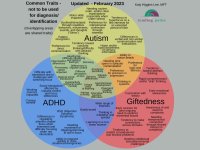
I was diagnosed Asperger's early on, at 5. It got folded into ASD more broadly in the DSM-5, but I still think the label is useful because it's a semi-recognized term for describing a distinct group of spectrum-ites, vs. someone who might be non-verbal. I think there are broader taxonomical subgroups, and the DSM-5 really should've leaned into that instead of flattening it into a spectrum (which is fairly useless, because every single person is on the spectrum, it's why it's a spectrum!). I mean, look at Emily's cool infographic. Spectrum.

In terms of medications, it's important to take that very, very seriously. Everyone has different interactions with medications, so it's a matter of figuring out what works best for you in relation to improving your quality of life and allowing you to do/focus on the things you want. I wouldn't necessarily tell anyone that they absolutely must go on so-and-so medication, because your neurochemicals and pathways vary from other people's.

Case in point, I stopped taking one of my anti-depressants about a year ago (tapered off, with doctor supervision), which I'd been on since 2021 after adding it to the one I'd been taking for 10+ years. Taking that out of my system has made a huge difference in my level of being able to, you know, feel anything, which was the whole reason I tapered off of it in the first place. I feel like it's probably part of the reason I stopped writing for nearly 6 years, just not enough emotional interest/connection to the work, easier to focus on the job because apparently existing in the world requires money. Now that I'm off it, I'm deriving pleasure from writing again, and it's been such a relief to know I wasn't doomed never to write again. Factors like that are important in choosing medications if you go that route after a diagnosis.

Also, absolutely stealing "neurospicy." Thanks, @PennyThompson. Your royalty check should be in the mail soon.
 
Back
Top