PennyThompson
"Oddly Sweet"
- Joined
- Nov 17, 2024
- Posts
- 1,757
Background
"It Just Ain't Going to Happen," by @Actingup and myself, was kind of an experiment in writing for the Loving Wives category. It was about estrangement and separation in a failed marriage, but it wasn't about infidelity. It was more or less equally split between the man's PoV and the woman's PoV. It had a (spoiler alert) happy ending.
It also ended up earning a "Hot" tag, coming to rest at 4.52 with ~2,000 votes (the story is hosted on Acting's account, so I don't have the exact vote count), and generated almost 200 comments. I'm not a professional researcher, but I know enough about research to get myself into trouble, and to me that number looked like a relevant sample size!
This analysis and my conclusions are my own, and don't necessarily reflect ActingUp's opinions!
Methodology
After removing comments by Acting and myself (mostly Acting, on account of me not wanting to put my mouth in the lion's jaws) we had 186 comments left by readers. I analyzed each comment on two axis, Detail and Tone.
For Detail, I categorized each comment as either being Low-Detail, High-Detail, or Mid-Detail. Low-Detail comments tended to be one or two sentences that either expressed positive or negative feelings, but didn't provide any significant critical commentary on the story. High-Detail comments went on at some length -- ranging from five or six sentences up to several paragraphs -- and included significant analysis multiple aspects of the writing, plot, characterizations, or concepts. Mid-Detail comments were around the three to five-sentence range, and provided one to three specific pieces of feedback beyond the commenter's subjective reaction.
For Tone I categorized each comment as either being Positive, Negative, or Neutral/Mixed, based on whether the content of the comment was unreservedly positive, unreservedly negative, or had a mixture of positive and negative content.
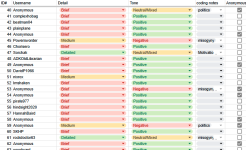
(Here's a little glimpse of my workflow, unfortunately I can't post a link to a google sheets document here!)
Some quick numbers
This is the part that I found fascinating, and that prompted me to do this analysis.
Of the 26 High-Detail comments:
While reading through the high-detail content, it became clear to me that a significant number of Loving Wives readers were highly analytical and enjoyed investigating and reflecting on the motivations, ethical choices, and emotional states of characters in a way that I have rarely seen in comments in other story categories.
A number of these high-detail commenters seemed to engage with the characters as real people, and not fictional characters. Several commenters seemed more interested in whether or not they agreed with the moral decisions made by the characters than with any literary merits of the story.
Several commenters pointed out perceived plot holes and logic flaws, regional accuracies and inaccuracies,
The worst guy you have ever met in your life
I identified 9 comments (4.8% of total comments) that were highly mysoginistic, and used hateful and sexist language about the female characters in the story. Not simply criticisms of the writing, plot, or characterization, but direct attacks on the female characters in one way or another. "Unbearable cunt," "autistic shrew," "narcissistic bitch," etc.
6 of the mysoginistic commenters were anonymous, and 3 used their named accounts.
There were also 2 comments that appeared to be from covid denialists (part of the story's plot takes place during the pandemic).
On the positive side, there were 2 commenters that explicitly called out the mysoginistic comments, using words like "incels" and "woman-haters" to describe them. Both of these commenters were anonymous.
Conclusions
The Loving Wives story category has a reputation for being divisive, negative, and toxic. That contingent certainly exists, some of the comments on our story made me uncomfortable, and I was grateful to Acting for publishing the story on his account so that I didn't feel as directly targeted by them.
On the other hand, engagement for this story was through the roof, significantly higher than any of my non-LW stories. Many of the comments were highly detailed, reflective, nuanced and constructive. The majority of readers seemed very receptive to our attempt at writing a nuanced story without a villainous wife and a heroic guiltless husband. Several comments were specifically thankful for an LW story that avoided some of the tropes and excesses of the genre.
Do I currently have any interest in writing for the category again? Personally, no. But I do have a greater appreciation for the genre and its audience!
"It Just Ain't Going to Happen," by @Actingup and myself, was kind of an experiment in writing for the Loving Wives category. It was about estrangement and separation in a failed marriage, but it wasn't about infidelity. It was more or less equally split between the man's PoV and the woman's PoV. It had a (spoiler alert) happy ending.
It also ended up earning a "Hot" tag, coming to rest at 4.52 with ~2,000 votes (the story is hosted on Acting's account, so I don't have the exact vote count), and generated almost 200 comments. I'm not a professional researcher, but I know enough about research to get myself into trouble, and to me that number looked like a relevant sample size!
This analysis and my conclusions are my own, and don't necessarily reflect ActingUp's opinions!
Methodology
After removing comments by Acting and myself (mostly Acting, on account of me not wanting to put my mouth in the lion's jaws) we had 186 comments left by readers. I analyzed each comment on two axis, Detail and Tone.
For Detail, I categorized each comment as either being Low-Detail, High-Detail, or Mid-Detail. Low-Detail comments tended to be one or two sentences that either expressed positive or negative feelings, but didn't provide any significant critical commentary on the story. High-Detail comments went on at some length -- ranging from five or six sentences up to several paragraphs -- and included significant analysis multiple aspects of the writing, plot, characterizations, or concepts. Mid-Detail comments were around the three to five-sentence range, and provided one to three specific pieces of feedback beyond the commenter's subjective reaction.
For Tone I categorized each comment as either being Positive, Negative, or Neutral/Mixed, based on whether the content of the comment was unreservedly positive, unreservedly negative, or had a mixture of positive and negative content.
(Here's a little glimpse of my workflow, unfortunately I can't post a link to a google sheets document here!)
Some quick numbers
- 62 (34%) comments were anonymous.
- 147 comments (79%) were positive, 22 comments (11.8%) were neutral/mixed, and 17 comments (9.1%) were negative.
- 125 comments (67.2%) were Low-Detail, 35 comments (18.8%) were Mid-Detail, and 26 comments (14%) were High-Detail.
This is the part that I found fascinating, and that prompted me to do this analysis.
Of the 26 High-Detail comments:
- 3 comments (11%) were strictly negative.
- 11 comments (42%) were mixed or neutral
- 12 comments (46%) were strictly positive
- 13 comments (50%) were anonymous (!)
- All 3 negative comments were anonymous.
- 5 positive and 5 mixed/neutral comments were anonymous.
While reading through the high-detail content, it became clear to me that a significant number of Loving Wives readers were highly analytical and enjoyed investigating and reflecting on the motivations, ethical choices, and emotional states of characters in a way that I have rarely seen in comments in other story categories.
A number of these high-detail commenters seemed to engage with the characters as real people, and not fictional characters. Several commenters seemed more interested in whether or not they agreed with the moral decisions made by the characters than with any literary merits of the story.
Several commenters pointed out perceived plot holes and logic flaws, regional accuracies and inaccuracies,
The worst guy you have ever met in your life
I identified 9 comments (4.8% of total comments) that were highly mysoginistic, and used hateful and sexist language about the female characters in the story. Not simply criticisms of the writing, plot, or characterization, but direct attacks on the female characters in one way or another. "Unbearable cunt," "autistic shrew," "narcissistic bitch," etc.
6 of the mysoginistic commenters were anonymous, and 3 used their named accounts.
There were also 2 comments that appeared to be from covid denialists (part of the story's plot takes place during the pandemic).
On the positive side, there were 2 commenters that explicitly called out the mysoginistic comments, using words like "incels" and "woman-haters" to describe them. Both of these commenters were anonymous.
Conclusions
The Loving Wives story category has a reputation for being divisive, negative, and toxic. That contingent certainly exists, some of the comments on our story made me uncomfortable, and I was grateful to Acting for publishing the story on his account so that I didn't feel as directly targeted by them.
On the other hand, engagement for this story was through the roof, significantly higher than any of my non-LW stories. Many of the comments were highly detailed, reflective, nuanced and constructive. The majority of readers seemed very receptive to our attempt at writing a nuanced story without a villainous wife and a heroic guiltless husband. Several comments were specifically thankful for an LW story that avoided some of the tropes and excesses of the genre.
Do I currently have any interest in writing for the category again? Personally, no. But I do have a greater appreciation for the genre and its audience!


 , that LW has only incels and psychos as the audience. The claim has always been that they are merely the loudest and that they pollute the category that has a wide and often thoughtful readership.